- All
- Product Name
- Product Keyword
- Product Model
- Product Summary
- Product Description
- Multi Field Search

Views: 176 Author: Site Editor Publish Time: 2026-05-11 Origin: Site


Piping engineers face immense challenges managing large-bore fluid networks. Facility managers know the constant risks of massive fluid handling. Moving water through a 10-inch pipeline generates extraordinary physical stress. Unchecked pump vibration severely damages adjacent mechanical equipment over time. Thermal expansion causes rigid pipes to buckle under extreme pressure. You must deploy robust mitigation strategies to protect the infrastructure. A component failure at the DN250 scale yields catastrophic consequences quickly. Flooding causes severe facility downtime and highly disruptive water damage.
Engineers must carefully scrutinize every connection point in the system. We will examine why combining Nitrile Butadiene Rubber (NBR) with a single-sphere design works best. This combination delivers the optimal technical choice for specific industrial pipelines. It perfectly suits high-rise water supply networks exposed to harsh conditions. You will discover exactly how material precision prevents sudden blowout. We will guide you through structural integrity, manufacturing quality, and installation criticality. By mastering these concepts, you ensure safe and long-lasting pipeline operations.
Material Precision: NBR is essential when water systems carry trace oils, chemicals, or industrial runoff where standard EPDM would degrade.
Structural Integrity: A single sphere joint at the DN250 scale offers the best balance between absorbing vibration and maintaining high-pressure burst resistance.
Manufacturing Quality: Specifying molded manufacturing processes significantly reduces the risk of delamination and premature failure.
Implementation Criticality: Successful deployment of a DN250 expansion joint relies heavily on exact flange matching and proper torqueing procedures.
Selecting an incorrect elastomer guarantees premature system failure. A misaligned water system connector simply cannot survive harsh industrial conditions. Engineers frequently debate selecting EPDM versus NBR materials during the design phase. EPDM functions as the standard default for pure, potable water lines. It also performs exceptionally well in closed HVAC chilled water systems. However, EPDM degrades rapidly when it touches any form of oil.
Consider the daily chemical interactions inside your pipeline. Pump lubrication systems frequently leak microscopic amounts of oil into the fluid stream. Industrial runoff introduces unknown chemical variables into the circulating water. EPDM absorbs these aggressive hydrocarbons rapidly. It swells dramatically, loses its tensile strength, and ultimately degrades. NBR fundamentally resists this severe chemical attack. Its specialized molecular structure repels oils and mild chemicals effectively.
NBR becomes an absolute necessity for industrial cooling loops. It remains mandatory for wastewater networks and high-rise drainage pipes. These environments frequently introduce trace hydrocarbons into the fluid stream. Mild chemicals and oily runoff destroy standard rubber surprisingly fast. Utilizing an NBR rubber expansion joint stops premature swelling immediately. It prevents the rubber body from hardening, cracking, and eventually blowing out. This specific material choice drastically extends your maintenance cycles. You prevent emergency mechanical shutdowns by matching the elastomer perfectly to the fluid chemistry.
Large-diameter pipelines demand exceptional structural rigidity to survive daily operations. The physical shape of the elastomer directly dictates its burst resistance. We must carefully evaluate single versus twin sphere configurations here. A twin sphere design certainly offers maximum axial and lateral movement capabilities. Yet, it creates a dangerous weak point exactly at the middle metal ring. This vulnerability drastically reduces overall pressure tolerance in 10-inch pipeline applications.
Let us examine the intense fluid dynamics involved. A 10-inch pipe moves thousands of gallons per minute constantly. Internal turbulence creates massive fluid drag and uneven component wear. A twin sphere joint exacerbates this dangerous turbulence. The middle ring creates an unnecessary structural bottleneck inside the flow path. Conversely, a single sphere joint provides a thicker, continuous internal arch profile. Heavy-duty water lines benefit immensely from this unbroken structural geometry.
This inherent rigidity minimizes internal fluid turbulence significantly. It maximizes pressure retention across the entire mechanical room. We find this design perfectly suited for complex high-rise water supply networks. These systems prioritize absorbing severe pump vibration over massive axial pipe elongation. Engineers often refer to these violent system vibrations as water hammer. A properly specified DN250 expansion joint absorbs these hydraulic shocks efficiently. It maintains a highly secure structural boundary during extreme pressure fluctuations.
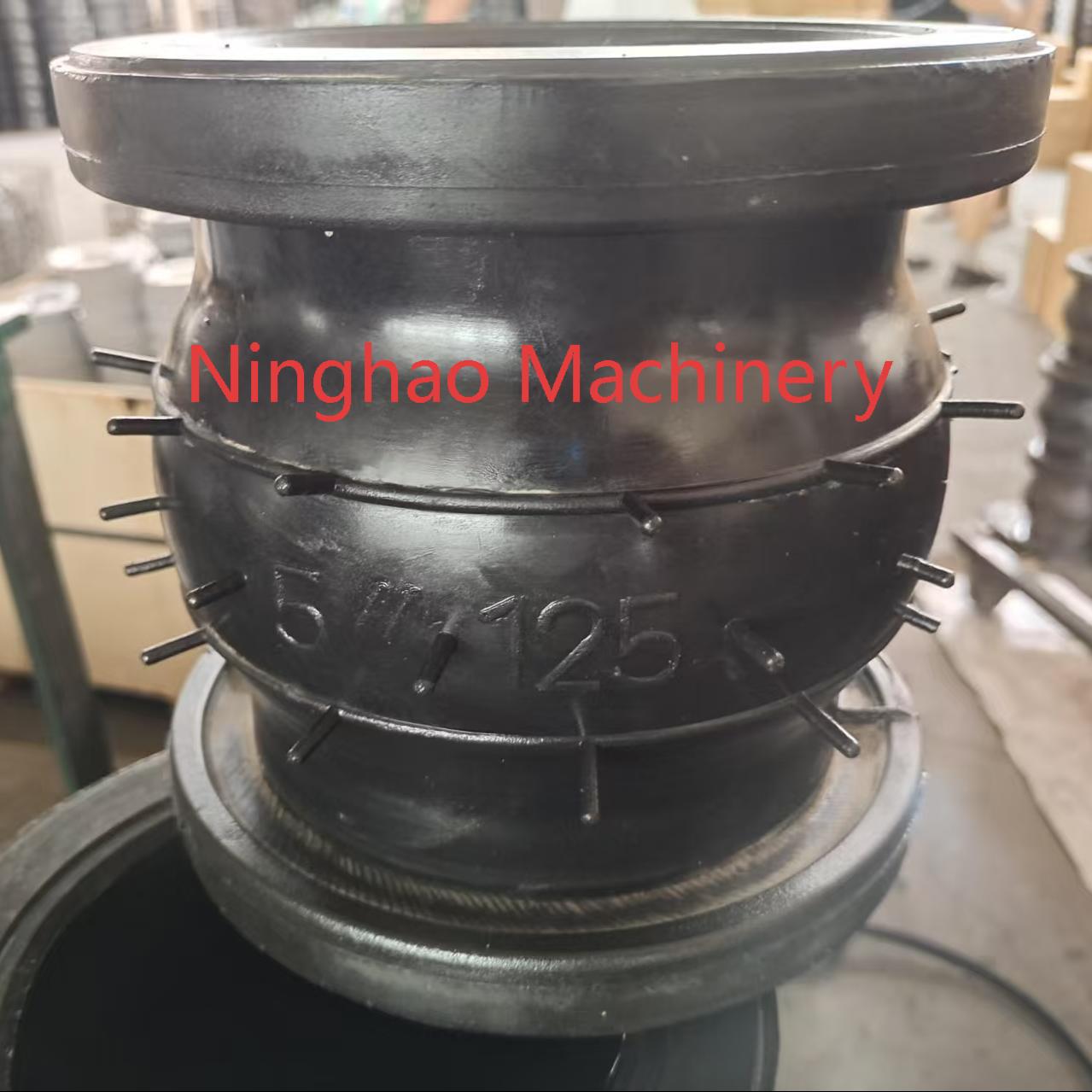
Evaluating a 10-inch component requires strict attention to precise engineering parameters. You must verify exact Face-to-Face (L) dimensions before ordering any replacement parts. Retrofit applications fail instantly if the new unit length varies even slightly. You cannot stretch a massive rubber component to close a large piping gap. Doing so compromises its structural integrity immediately. Pressure ratings need precise mapping against your maximum system head pressure. Common regional standards include PN10, PN16, or ANSI 150 pressure classes.
Flange specifications remain equally critical to long-term operational safety. You must assess the metal retaining flanges very carefully. Manufacturers typically offer standard carbon steel or robust forged steel options. Surface treatments matter immensely for external corrosion resistance. Damp mechanical rooms rust untreated carbon steel extremely fast. Galvanized finishes offer basic protection against ambient room moisture. Epoxy coatings provide superior, long-lasting durability in highly aggressive environments. Performance metrics dictate exactly how well the rubber compensator handles severe physical stress.
Movement Category | Typical DN250 Tolerance Range | System Impact & Purpose |
|---|---|---|
Axial Compression | 20mm - 25mm | Safely absorbs linear thermal pipe expansion during temperature spikes. |
Axial Extension | 12mm - 16mm | Accommodates pipe contraction without causing severe flange pull-out. |
Lateral Deflection | 15mm - 20mm | Forgives minor pipe misalignment naturally occurring during field assembly. |
Angular Movement | 10° - 15° | Reduces severe bending stress on expensive adjacent mechanical equipment. |
These specific baseline tolerances ensure the component functions predictably. Operating beyond these stated parameters guarantees rapid structural failure. Always consult the specific manufacturer engineering submittals to verify these limits.
Manufacturing methodology directly determines the actual field lifespan of the product. You must distinguish clearly between fully molded and hand-built production processes. A fully molded, pressurized vulcanization process proves vastly superior every time. We strongly recommend this modern method for any NBR pipe connector. Molded construction ensures perfectly uniform wall thickness everywhere. It guarantees consistent nylon-cord reinforcement alignment inside the solid rubber matrix.
Hand-built joints rely heavily on manual labor. Factory workers wrap layers of raw rubber and fabric manually around a steel core. This outdated process introduces inevitable human error and inconsistent material tension. Air pockets become trapped between the inner layers very easily. Molded vulcanization happens inside a massive steel die under intense heat. The hydraulic press squeezes out every single air bubble during curing. This highly precise manufacturing entirely eliminates weak seams and hidden material voids.
Conversely, you must rigorously avoid non-molded or multi-piece bonded alternatives. These vastly inferior options suffer from poor layer adhesion constantly. They remain highly prone to catastrophic layer separation during normal operation. Sudden hydraulic shock easily tears these weakly bonded layers apart. Heavy-duty pump discharges frequently generate these extreme pressure spikes. You successfully mitigate these dangerous risks by specifying exclusively molded construction. Your heavy-duty NBR joint requires this specific level of engineering trust. Consistent factory vulcanization yields reliable, leak-free field performance for decades.
Field deployment introduces severe, often overlooked operational risks. DN250 lines generate massive internal thrust forces continuously. These extreme dynamic forces can easily destroy an unrestrained pipeline assembly. The thrust forces act exactly like a massive hydraulic cylinder. Without restraints, the internal pipe pressure pushes the metal flanges apart. The rubber stretches violently until the internal nylon cords snap. The threat of joint over-extension remains a constant, hidden danger.
You must absolutely mandate the use of mechanical Control Units. Engineers commonly refer to these essential safety components as tie rods. These rigid metal rods physically prevent the rubber from stretching past its limits. They handle the static pressure thrust entirely, protecting the rubber body. Flange mating presents another critical, frequent point of failure. We strongly warn against using slip-on raised-face (SORF) mating flanges. The surprisingly sharp raised metal face easily cuts directly into the rubber. This mechanical damage causes immediate, unrepairable system leaks. You must insist on installing flat-face mating flanges exclusively. Alternatively, install appropriate flat transition gaskets to protect the sensitive rubber face.
Strict torque protocols prevent uneven flange compression during assembly. Uneven compression remains a primary, preventable cause of early-life failures. Follow this exact bolting sequence to ensure total installation success:
Clean all mating pipe flanges thoroughly to remove stubborn rust and debris.
Align the heavy pipes perfectly without relying on the inherent rubber flexibility.
Insert all metal bolts and carefully hand-tighten the nuts equally.
Apply mechanical torque using a strictly diagonal, cross-bolting star pattern.
Perform the final tightening in three gradual, controlled stages (e.g., 30%, 60%, 100% torque).
Following exact installation protocols guarantees a durable, completely leak-free mechanical seal. Skipping any step compromises the entire piping network.
Securing long-term pipeline integrity requires highly methodical component evaluation. You must base your final procurement strictly on confirmed NBR media compatibility. Require absolute molded construction certification to avoid dangerous delamination risks in the field. Always verify exact flange dimensional standards like DIN, ANSI, or JIS before issuing purchase orders.
Before finalizing your Bill of Materials, recommend engineers take these actionable steps:
Request specific pressure-temperature (P-T) de-rating curves directly from the supplier.
Obtain accurate cross-sectional CAD drawings to confirm the inner arch thickness.
Validate the mandatory inclusion of control rods for your specific system layout.
Confirm the exact surface treatment applied to the metal retaining flanges.
A: Generally, no. NBR is optimized for oil resistance. For potable high-rise water systems, EPDM with appropriate NSF/WRAS certifications is required. NBR is reserved for industrial/wastewater applications.
A: The most common causes are improper torque sequencing during installation, the use of incompatible raised-face mating flanges, or lacking control rods leading to joint distortion under pressure.
A: Yes, if the adjacent piping is not fully anchored. Control rods absorb static pressure thrust, ensuring the joint solely handles vibration and thermal movement without blowing out.
A: While standards vary slightly by region and manufacturer, a common industry standard length for a DN250 (10") single sphere rubber compensator is typically around 250mm to 260mm, but exact manufacturer submittals must be checked prior to piping design.