- All
- Product Name
- Product Keyword
- Product Model
- Product Summary
- Product Description
- Multi Field Search

Views: 0 Author: Site Editor Publish Time: 2026-11-22 Origin: Site


Industrial piping systems face constant physical stress. Unmanaged thermal expansion, aggressive pump vibration, and slight piping misalignment inevitably lead to severe trouble. They trigger premature system wear and often cause catastrophic flange failures. You cannot ignore these destructive forces in heavy-duty utility lines.
A neoprene rubber expansion joint paired alongside carbon steel flanges acts as the reliable industry-standard baseline. We see this exact configuration deployed extensively across HVAC systems, water cooling loops, and mild chemical processing applications. It balances physical resilience and budget efficiency perfectly.
This article provides a strict, evidence-based framework for evaluating these components. We will help piping engineers and procurement teams specify and install these joints correctly. You will learn how to secure your pipelines without over-engineering or under-speccing the solution.
Material Baseline: Neoprene (Polychloroprene) offers an optimal mid-range resistance to moderate chemicals, ozone, and petroleum-based oils, outperforming EPDM in oil-contact scenarios.
Configuration Impact: Choosing between a single sphere and a double sphere rubber expansion joint directly dictates allowable multi-directional movement and acoustic dampening capabilities.
Flange Economics: Carbon steel flanges provide necessary structural rigidity at a lower cost than stainless steel, requiring only standard zinc plating or epoxy coatings for most non-corrosive external environments.
Risk Mitigation: Over 70% of premature failures stem from improper installation (e.g., missing control rods, incorrect mating flanges, or over-torquing), not manufacturing defects.
Plant managers need reliable methods to isolate vibration and accommodate thermal cycles. Standard utility piping undergoes constant expansion and contraction. We require cost-effective ways to manage this movement. Defaulting to expensive specialty alloys or premium elastomers often wastes project budgets. You need a practical, durable solution for everyday industrial challenges.
Neoprene, scientifically known as polychloroprene, delivers excellent mechanical toughness. It serves as an optimal mid-range elastomer for diverse industrial media.
You must understand its operational thresholds before specifying it. Manufacturers generally rate standard neoprene for temperatures up to 225°F (107°C). Operating strictly below this limit prevents premature hardening and cracking. If your process frequently spikes above this temperature, the rubber will degrade rapidly.
Neoprene provides exceptional media suitability for common utility lines. It proves ideal for chilled water systems and condenser water cooling loops. You will frequently find these loops inside large chemical plants. Furthermore, neoprene handles compressed air containing trace petroleum-based compressor oils easily. EPDM materials fail quickly under similar oil-contact conditions. This makes neoprene a safer, more versatile choice for mixed-use industrial environments.
The metal components play an equally critical role in joint survival. Carbon steel flanges provide massive structural rigidity. They handle high-pressure clamping forces without warping.
They also offer a major structural advantage during installation. Most elastomer joints feature floating or rotating flanges. These flanges spin freely behind the rubber bead. They allow for significantly easier bolt hole alignment. Pipe fitters save hours of labor compared to installing rigid, fixed flanges.
However, we must address corrosion protection realities. Raw carbon steel rusts aggressively in humid industrial settings. You must specify appropriate external finishes. Zinc-plated, galvanized, or epoxy-painted finishes prevent rapid oxidation. These standard coatings provide decades of external protection. They keep the assembly structurally sound without the high expense of solid stainless steel.
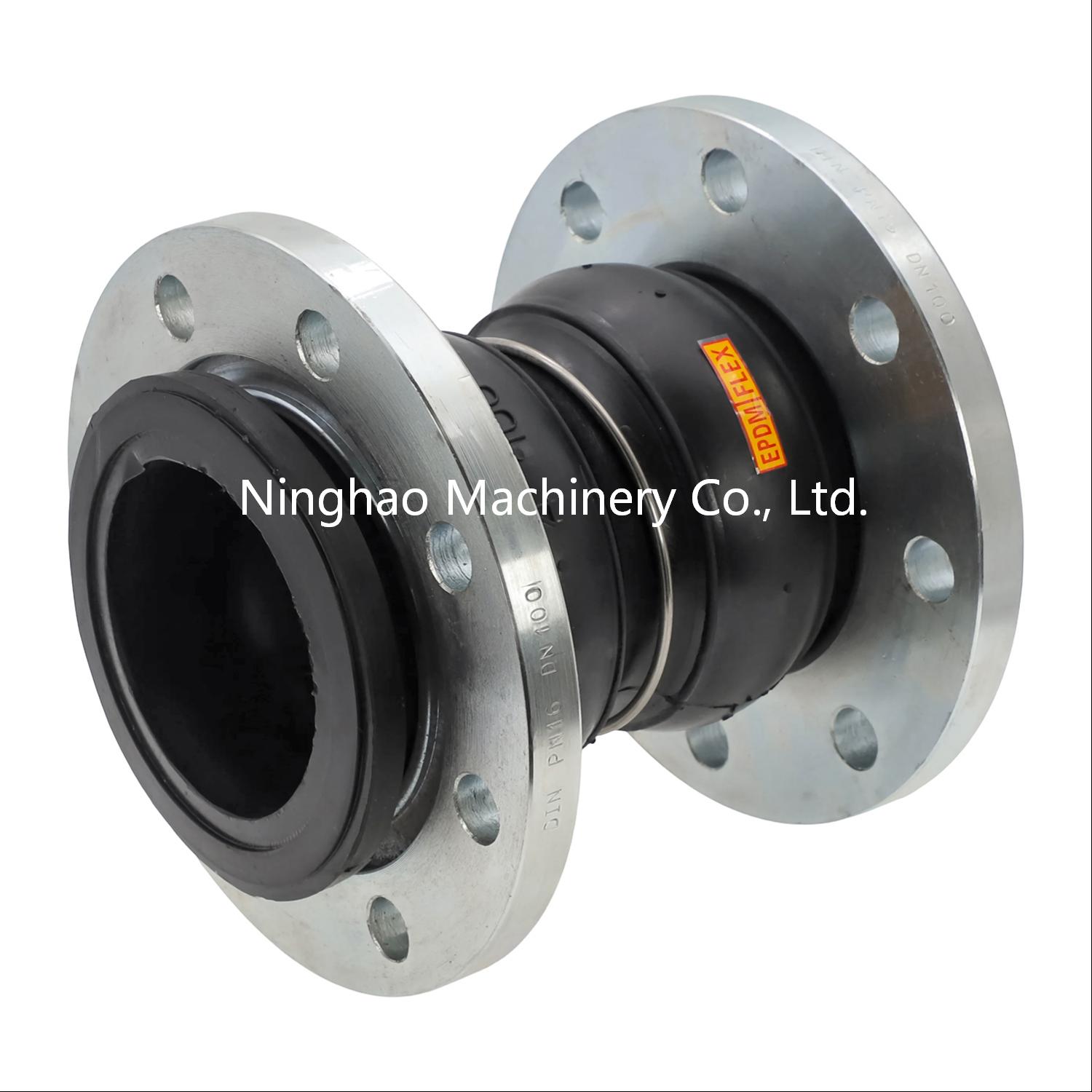
Choosing the correct body shape dictates the success of your vibration isolation strategy. Engineers typically select between single and dual-arch designs based on available space and movement requirements.
Single sphere configurations feature one continuous rubber arch. They excel in applications presenting tight spatial footprints. When you have minimal face-to-face dimensions available between pipe ends, single spheres fit perfectly.
They efficiently handle standard axial compression and extension. However, they possess distinct limitations. A single arch provides a lower threshold for lateral and angular deflection. If your pipes experience severe sideways shifting, a single sphere might tear under the stress.
More demanding environments require enhanced flexibility. A double ball neoprene rubber joint serves as the premier choice for high-vibration systems. You should specify this configuration when facing significant pipe misalignment.
The performance difference remains substantial. The dual-arch design of a double sphere rubber expansion joint provides exponentially higher acoustic dampening. The extra rubber mass and secondary arch absorb aggressive pump frequencies effectively. It also accommodates much greater multi-plane movements simultaneously.
We must acknowledge the implementation trade-offs. Double spheres require a considerably larger face-to-face installation gap. They are also more susceptible to "squirm" under high internal pressure. Squirm occurs when the joint bulges and twists laterally. You must properly restrain these joints to prevent catastrophic blowouts.
Table 1: Configuration Tolerance Comparison
Configuration Type | Axial Movement Capacity | Lateral Deflection Capacity | Acoustic Dampening | Space Requirement |
|---|---|---|---|---|
Single Sphere | Moderate | Low to Moderate | Standard | Minimal |
Double Sphere | High | High | Exceptional | Substantial |
Proper specification requires strict attention to pressure capacities and mating standards. Ignoring these technical parameters invites immediate system failure upon startup.
Every joint carries specific operational limits based on its internal diameter (ID). Smaller joints handle higher pressures. Larger joints see their maximum pressure ratings drop. Standard operating pressures typically range from 150 PSI to 225 PSI. You must verify these ratings against your system's peak surge pressure.
We must also address vacuum constraints carefully. Many engineers forget to account for negative pressure. When installing these components on pump suction lines, full vacuums often occur. Standard rubber spheres can collapse inward during intense pump suction phases. You must highlight when internal vacuum rings are mandatory. These metal rings sit inside the rubber arches. They physically prevent the joint from imploding under negative pressure.
A properly specified flanged rubber expansion joint must perfectly align with your existing pipeline hardware. You must detail common bolt circle drillings during procurement. Standard North American systems use ASME/ANSI B16.5 Class 150 dimensions. European and international systems frequently utilize DIN PN10 or PN16 standards. Verify your pipe flange standards before ordering.
Mating surface compatibility stands as a critical warning point. Rubber expansion joints must mate against strictly flat-face flanges. This rule remains absolute.
Many contractors mistakenly use raised-face mating flanges. A raised-face flange exerts uneven clamping force. It will aggressively cut into the integral rubber bead when tightened. This improper installation slices the rubber, causes immediate leaks, and instantly voids all manufacturer warranties. If you only have raised-face flanges available, you must install rigid spacer rings to create a flat mating surface.
Even perfectly specified components will fail if installed poorly. Field installation realities often dictate the ultimate lifespan of your vibration isolation strategy.
Control units, commonly called tie rods, represent a critical safety mechanism. We must define their absolute necessity clearly. Control units are completely non-negotiable in unanchored piping systems.
Internal fluid pressure creates massive thrust forces. This pressure thrust pushes adjacent pipes apart. Without massive concrete anchors, the pipes will separate. The rubber joint will over-elongate past its structural design limits. The rubber will tear, releasing high-pressure fluid. Control rods physically link the mating flanges together. They allow normal vibration but mechanically prevent the joint from stretching to the point of failure.
Field technicians frequently overlook torque sequencing. You cannot simply tighten bolts in a circle. You must detail the requirement for strict star-pattern cross-tightening.
Installers must apply torque in gradual, alternating stages. They must respect specific maximum torque limits. Over-torquing crushes the integral rubber flange. It breaks the internal reinforcing fabrics and guarantees a blowout.
Environmental degradation also causes quiet, long-term failures. Neoprene proves highly weather-resistant overall. However, intense, direct UV light eventually hardens the elastomer. Localized heat sources pose a more immediate threat. Unshielded welding near the joint drastically reduces its lifespan. Stray sparks will burn holes directly through the pressurized rubber.
Best Practices for Field Installation:
Always use a calibrated torque wrench.
Inspect mating flanges for sharp burrs or deep scratches.
Cover the joint with a welding blanket during nearby hot work.
Never paint the flexible rubber body, as solvents destroy the elastomer.
Procurement teams need an objective evaluation method. Eliminating guesswork ensures you buy the right component the first time. We recommend utilizing the "STAMP" framework to finalize your selection.
Follow these five criteria to guarantee component compatibility:
Size: Accurately verify the nominal pipe size. Measure the exact face-to-face dimensions available in the piping gap.
Temperature: Distinguish between normal operating temperatures and extreme surge temperatures. Ensure neither exceeds 225°F.
Application: Confirm neoprene remains the correct elastomer choice. Compare it against EPDM, Nitrile, or PTFE-lined options based on your specific industry needs.
Media: Cross-reference the specific internal fluid or gas against a certified neoprene chemical compatibility chart. Check for trace aggressive chemicals.
Pressure: Factor in generous safety margins. Account for sudden pump surges, valve closures, and intense water hammer events.
Selecting the right manufacturing partner matters just as much as the physical specifications. Look for manufacturers providing transparent, documented burst pressure testing data. They should willingly supply raw material certificates upon request. Furthermore, quality vendors provide clear, comprehensive installation manuals. A vendor hiding their testing data often supplies inferior, heavily diluted rubber compounds.
A neoprene rubber expansion joint paired with carbon steel flanges represents a highly reliable, economical solution. It manages aggressive vibration and unavoidable thermal expansion effectively. You will achieve decades of leak-free service provided the operational parameters are strictly respected.
You must prioritize precise dimension checks and flat-face mating surfaces. Do not ignore the critical necessity of control rods in unanchored lines. As a next action, advise your engineering team to audit your current piping system’s anchor points. Verify peak operating pressures and maximum thermal limits before submitting a final RFQ to your suppliers.
A: Typically no. Standard neoprene is not FDA or NSF-61 certified for potable water. EPDM with proper certifications is required for those applications.
A: No. The rubber body forms a full-face integral flange that acts as its own gasket. Adding secondary gaskets can cause leaks or uneven compression.
A: 5 to 10 years, heavily dependent on cycle frequency, temperature stability, and whether control rods were correctly utilized to prevent over-extension.
A: Yes, but they must be specified with a robust zinc plating, hot-dip galvanization, or marine-grade epoxy to prevent rapid rust development.