- All
- Product Name
- Product Keyword
- Product Model
- Product Summary
- Product Description
- Multi Field Search

Views: 181 Author: Site Editor Publish Time: 2026-08-06 Origin: Site


Industrial pipelines face constant stress from relentless fluid dynamics. Rapid thermal shifts also strain these mechanical systems daily. Acoustic transfer and mechanical vibration constantly threaten overall operational integrity. Rigid metal piping struggles against these dynamic forces across complex HVAC environments. Single-arch alternatives sometimes lack the flexibility required for severe structural movement. You need a specialized isolation component to solve these demanding engineering challenges.
Enter the double sphere rubber expansion joint. Manufacturers designed this specific component for enhanced movement accommodation. It outperforms traditional rigid pipes and standard single-arch connectors easily. This dual-arch design absorbs immense mechanical stress while maintaining a perfect hydraulic seal.
We designed this guide to help engineers and procurement teams navigate these critical components. You will discover a transparent, specification-driven framework to evaluate these isolation units. We provide actionable insights for selecting and installing these products safely. You will explore material selection, performance specifications, and critical safety protocols. This knowledge ensures your commercial systems remain secure and highly efficient under intense pressure.
Double-sphere joints offer significantly higher axial and lateral deflection capabilities than single-sphere alternatives, acting as a critical pipeline shock absorber.
Material selection (e.g., EPDM vs. Nitrile) strictly dictates the joint's operational lifespan, chemical resistance, and temperature thresholds.
Proper installation requires mandatory control units (tie rods) in unanchored systems to prevent catastrophic over-extension under pressure.
Procuring an OEM double sphere joint requires validating specific flange standards, pressure ratings, and certified burst testing data.
Heavy machinery generates intense, continuous vibrations. Pumps, chillers, and large compressors transmit mechanical noise directly into connected pipelines. You need a highly effective shock absorbing joint to protect the surrounding infrastructure. The dual-arch geometry actively disrupts acoustic frequencies. It breaks the sound waves traveling through the liquid media. The elastomeric body stops metal-to-metal contact entirely. This acoustic isolation significantly reduces ambient noise levels inside commercial buildings. You protect sensitive equipment from chronic vibration fatigue simultaneously.
Engineers rely on these components for multi-directional movement compensation. Thermal fluctuations cause metal pipes to expand and contract continually. Seismic events introduce sudden, violent structural shifts. Ground settlement creates gradual alignment issues. The dual-sphere design accommodates four distinct types of movement safely:
Axial Compression: The joint compresses inward seamlessly. Pumping systems expand linearly as fluid temperatures rise. The rubber arches fold slightly to absorb this exact structural growth.
Axial Extension: The spheres elongate outward naturally. Fluid temperatures drop during unexpected system shutdowns. The connected pipes contract and pull apart. The joint stretches to bridge this widening gap securely.
Lateral Deflection: The arches bend sideways safely. Pipelines often shift perpendicular to their main installation axis. The flexible twin-sphere body absorbs these off-center shear forces easily.
Angular Movement: The flexible body tilts effectively. Flanges rarely align perfectly in real-world construction. The rubber structure twists to accommodate minor angular pipe misalignment during active operation.
Pressure dispersal represents another critical engineering advantage. Internal fluid pressure creates immense stress on piping components. The unique twin-sphere geometry distributes this internal stress effectively. The curved arches spread out the hydraulic forces over a much larger surface area. This distribution mitigates pipeline fatigue at critical connection points. You significantly reduce the risk of structural failure over time.
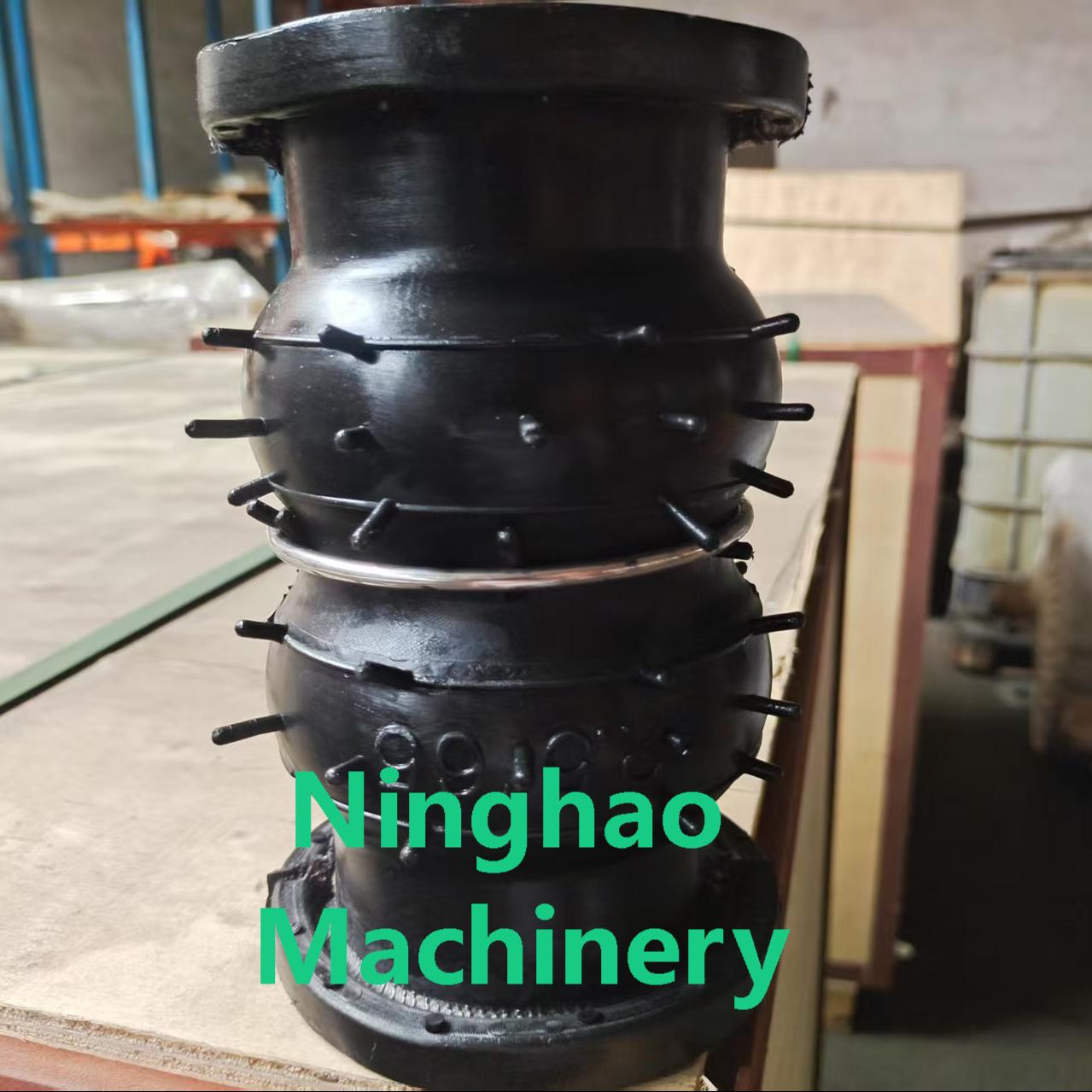
Engineers must choose between single-sphere and double-sphere designs frequently. Deflection capacity forms the primary physical difference here. A double sphere rubber joint typically allows for 30% to 50% more physical movement. Single spheres hit their mechanical limits much faster. The extra arch provides extended flexibility for severe thermal expansion. You gain a wider safety margin during unpredictable seismic activity.
However, you must carefully consider the spatial requirements. Twin-sphere designs require a substantially larger installation footprint. The face-to-face dimension is noticeably longer than standard models. Tight mechanical rooms sometimes lack the necessary clearance. You must measure the available pipeline gap perfectly before specifying a dual-arch model. Forcing a long joint into a short gap ruins the component.
Turbulence considerations also demand your immediate attention. The central void between the two spheres alters internal fluid dynamics. High-velocity systems might experience increased flow turbulence. The fluid tumbles slightly as it passes through the connecting rubber valley. You must account for potential pressure drops in highly sensitive hydraulic networks. Some manufacturers insert a central internal baffle to smooth this flow.
We created a straightforward evaluation matrix to simplify your selection process. Use this framework to evaluate your specific application needs objectively.
Design Selection Matrix
Application Criteria | Single-Sphere Recommendation | Double-Sphere Recommendation |
|---|---|---|
Space Availability | Ideal for tight, restricted pipeline spaces. | Requires ample face-to-face installation clearance. |
Movement Requirements | Adequate for minor to moderate physical shifts. | Mandatory for high seismic or massive thermal changes. |
Vibration Intensity | Sufficient for standard commercial pump isolation. | Superior for heavy, continuous industrial vibrations. |
Fluid Velocity | Preferred for ultra-high velocity fluid flows. | Requires engineering review for turbulence potential. |
The elastomer material dictates the operational success of your entire system. You cannot use a universal rubber compound for all industrial fluids. A standard water system rubber joint typically relies on EPDM. Ethylene Propylene Diene Monomer serves as the absolute industry standard for HVAC networks. It handles chilled water and boiling hot water exceptionally well. EPDM provides excellent natural resistance to outdoor weathering and heavy ozone exposure. However, you must strictly observe its temperature limits. EPDM usually maxes out around 212°F (100°C) before degrading.
Nitrile, also known as Buna-N, serves an entirely different engineering purpose. You must choose Nitrile for systems involving industrial oils or petroleum-based fluids. Hydrocarbons will degrade standard EPDM components rapidly. Nitrile resists these aggressive chemical attacks effectively. It maintains its structural integrity perfectly when exposed to industrial lubricants or raw fuel lines.
Neoprene offers a versatile, middle-ground elastomeric option. Engineers frequently specify Neoprene for general wastewater applications. It handles moderate chemical exposure much better than pure EPDM. Neoprene also resists external physical abrasion quite well. We often see Neoprene specified in outdoor environments subject to harsh physical elements.
We strongly advise a strict validation check before purchasing any flexible unit. Buyers must demand official Material Data Sheets (MDS) from their chosen supplier. This paperwork prevents catastrophic misapplications.
Verify the inner tube material matches the fluid media precisely.
Confirm the outer cover material withstands the specific external environment.
Ensure the internal reinforcing fabrics align securely with your system temperatures.
Check for recognized industry certifications regarding potable water safety if applicable.
Procurement teams must evaluate technical specifications rigorously. Flange standards represent the first critical engineering checkpoint. The joint must mate perfectly to your existing metal pipeline. You must confirm strict compatibility across standard flange drilling patterns. Common global standards include ANSI 150/300, DIN PN10/PN16, and JIS specifications. You should also consider floating versus fixed metal flanges. Floating flanges rotate freely around the rubber bead. They make bolt alignment significantly easier during complex field installations.
You must understand pressure and temperature derating principles deeply. Heat and pressure share a critical, inverse mechanical relationship. High temperatures actively weaken all elastomeric compounds. A joint rated for 150 PSI at ambient temperature cannot hold that same pressure at 200°F. You must derate the maximum allowable pressure as system temperatures rise. Always consult the manufacturer's exact derating chart to ensure operational safety. Ignoring these charts causes sudden blowouts.
Sometimes standard catalog items fall short of specific project requirements. You should seek an OEM double sphere joint for highly specialized applications. OEM customization handles non-standard face-to-face lengths easily. Manufacturers can add specialized internal retaining rings for higher vacuum ratings. They can also engineer specific nylon or Kevlar reinforcing fabrics to meet extreme burst pressure requirements. Custom manufacturing ensures the component matches your exact engineering parameters.
Buyers should always ask for certified burst testing data. Reliable manufacturers conduct extensive hydrostatic testing on their custom designs. This physical testing proves the safety factor of the joint. You ensure the product withstands sudden pressure spikes safely. This data provides total peace of mind for engineering teams.
Proper installation determines the longevity of any flexible pipeline connector. Many catastrophic failures trace back directly to poor field installation practices. The necessity of control units remains a paramount engineering concern. You must install control units (tie rods) in any unanchored piping system. Internal fluid pressure creates massive thrust forces inside the pipeline. These invisible forces stretch the rubber body far beyond its natural limits. Control units act as non-negotiable safety devices. They physically prevent the joint from over-elongating and failing under massive thrust pressure.
Mating flange preparation demands careful, visual inspection. You must never install rubber joints directly against improper metal surfaces. Rough, serrated, or sharp-edged mating flanges slice right through the delicate rubber bead. You must use smooth, flat-face flanges whenever possible. If you must use raised-face flanges, you often need a specialized flat metal ring to prevent rubber damage.
Torque protocols require strict, unwavering adherence. You cannot tighten the flange bolts randomly or aggressively. Poor bolting practices destroy the internal wire reinforcement.
Always follow a progressive, star-pattern torque sequence strictly.
Tighten all bolts in multiple, even stages to ensure equal compression.
Avoid over-torquing the bolts under any field circumstances.
Excessive torque crushes the rubber bead completely and compromises the hydraulic seal.
Never paint the exterior of the rubber body, as paint solvents degrade the elastomer.
Evaluating flexible pipeline components requires a highly systematic approach. You must verify the specific fluid media and operating temperatures first. This crucial step determines your exact elastomeric material requirements. Next, you should calculate the required physical deflection limits. This specific calculation dictates whether you need a single-arch or a high-capacity twin-arch design. Finally, you must confirm the available physical space and match the flange specifications precisely.
We encourage buyers to take proactive next steps before final procurement. You should consult directly with technical sales teams to discuss your unique application. Request detailed submittal drawings to verify face-to-face dimensions. Always review specific sizing charts and temperature derating tables beforehand. These simple steps eliminate procurement guesswork and prevent costly field failures. Secure your industrial infrastructure by treating these flexible components as highly engineered mechanical assets.
A: Yes, they handle vacuum environments, but they often require physical modifications. Standard models primarily handle positive pressure safely. For high vacuum services, manufacturers must insert a specialized internal vacuum ring. This rigid steel ring prevents the rubber spheres from collapsing inward under negative pressure.
A: You can typically expect a lifespan of 5 to 10 years. However, this timeframe heavily depends on several external operating factors. High UV exposure, incompatible fluid media, and extreme temperature fluctuations shorten this lifespan considerably. Strict adherence to proper installation and specified torque specs maximizes overall longevity.
A: The elastomeric material provides excellent natural acoustic damping. It interrupts the rigid metal-to-metal contact path along the piping network. Mechanical vibrations from pumps cannot travel easily through the flexible rubber body. The dual-arch geometry further disrupts sound wave frequencies, significantly lowering overall ambient system noise.