- All
- Product Name
- Product Keyword
- Product Model
- Product Summary
- Product Description
- Multi Field Search

Views: 149 Author: Site Editor Publish Time: 2026-08-17 Origin: Site


Industrial piping systems face relentless dynamic forces. Thermal growth, aggressive vibration, and mechanical movement constantly threaten structural integrity. Engineers routinely face the challenge of accommodating these stresses. They must do so without compromising the primary fluid line. We introduce the epdm rubber expansion joint as the premier engineering solution. It currently serves as the recognized industry standard for water, HVAC, and mild chemical applications. EPDM delivers a highly specific and effective weathering and ozone resistance profile. This guide provides a strict, professional evaluation framework. We will help you specify the right flexible rubber expansion joint for your facility. You will learn to properly assess pressure, temperature, and complex movement requirements. Applying these engineering rules helps you avoid catastrophic and dangerous system failures.
Material Suitability: EPDM excels in hot/cold water, steam, and outdoor weathering but will fail rapidly if exposed to petroleum-based oils or hydrocarbons.
Movement Mitigation: Selecting between single-arch and double-arch designs dictates the joint's capacity to absorb axial, lateral, and angular piping deflections.
System Protection: Proper specification requires evaluating maximum operating limits against Fluid Sealing Association (FSA) standards, prioritizing control rods in high-pressure or unanchored systems.
Sourcing Protocol: Evaluating an OEM rubber connector manufacturer requires verifying flange drillings, pressure testing standards, and custom tooling capabilities.
Engineers frequently mismatch elastomer types to their fluid media. This oversight leads to premature degradation and dangerous blowout risks. Elastomer chemistry dictates component survival. You cannot simply install an EPDM joint into every pipeline. You must understand the material boundaries.
Ethylene Propylene Diene Monomer (EPDM) possesses exceptional chemical properties. It demonstrates extraordinary resistance to ozone, UV degradation, and general weathering. These traits make it ideal for rooftop HVAC systems and outdoor cooling towers. It will not crack or become brittle under direct sunlight.
The material also delivers excellent performance in specific liquid media. You can safely use it for hot and cold potable water. It handles wastewater and dilute acids smoothly. Many facilities rely on it to transport alkaline solutions safely. The internal rubber matrix remains stable when exposed to these specific fluids.
You must recognize the hard limitations of EPDM rubber. It has absolute zero resistance to petroleum oils. It fails rapidly in diesel fuel, kerosene, or mineral-oil-based fluids. Hydrocarbons attack the polymer chains immediately. The rubber will swell, lose tensile strength, and eventually rupture.
If your system contains any oily substances, you must avoid EPDM completely. We strongly advise steering your specification toward Nitrile (Buna-N) or Viton instead. Decision-makers must baseline their specific fluid media and ambient environment first. You must secure this data before proceeding to physical joint sizing.
Arch design directly correlates to the movement capacity of your joint. A properly selected arch profile dictates how much stress the connector can safely absorb. Engineers must match the arch configuration to the expected pipeline deflection.
Single arch designs serve as the baseline standard for vibration isolation. They perform best near mechanical equipment. You will typically install them at pump suction and discharge ports. The single arch easily handles standard axial compression and extension. It also tolerates minor lateral offset caused by operational shifting.
Double arch profiles are engineered for extreme movement capabilities. The addition of a second arch drastically increases flexibility. They are ideal for high angular or lateral deflection requirements. You should specify them where piping misalignment is a known variable. They prevent destructive stress from transferring to rigid pipe anchors.
You must also contrast the flange attachment methods. Full-face flanged spool types are heavy-duty and highly customizable. They integrate the rubber flange face directly with the elastomer body. Conversely, spherical types utilize floating metal flanges. Floating flanges rotate freely around the rubber bead. This rotation makes bolt alignment much easier during tricky installations.
Configuration Type | Primary Application | Movement Capacity | Flange Style |
|---|---|---|---|
Single Arch | Pump vibration isolation | Standard axial, minor lateral | Fixed Spool or Floating |
Double Arch | High misalignment areas | Extreme lateral and angular | Fixed Spool or Floating |
Spherical | Confined spaces, standard HVAC | Moderate omni-directional | Floating (Rotatable) |
Sizing a joint requires moving far beyond the nominal pipe size (NPS). You must evaluate dynamic operating conditions. An EPDM flexible joint behaves differently under varying thermal loads. A thorough engineering evaluation ensures long-term safety.
Engineers must understand the inverse relationship between temperature and pressure. As operating temperature rises, the maximum allowable working pressure (MAWP) strictly decreases. You cannot run maximum pressure at maximum temperature simultaneously. Standard EPDM limits generally peak around 212°F to 250°F (100°C to 120°C).
If your system pushes these thermal boundaries, standard fabric reinforcement will fail. Exceeding the 250°F threshold requires specialty reinforcement like Kevlar. Always consult a pressure-temperature derating curve provided by your manufacturer.
You must align manufacturer tolerances with existing pipe gaps. The relaxed length of the expansion joint must match the installation gap perfectly.
Measure the exact distance between mating pipe flanges.
Compare this gap against the manufacturer's published face-to-face dimension.
Ensure the joint isn't stretched or compressed to fit the gap.
Pre-stressing the elastomer during installation dramatically shortens its lifespan. The joint needs its full range of motion to absorb operational shocks.
Pump suction lines present a unique operational hazard. High vacuum conditions can cause standard rubber bodies to invert or collapse. You must specify whether internal reinforcing rings are necessary. These embedded steel rings prevent the arch from collapsing inward under heavy vacuum loads.
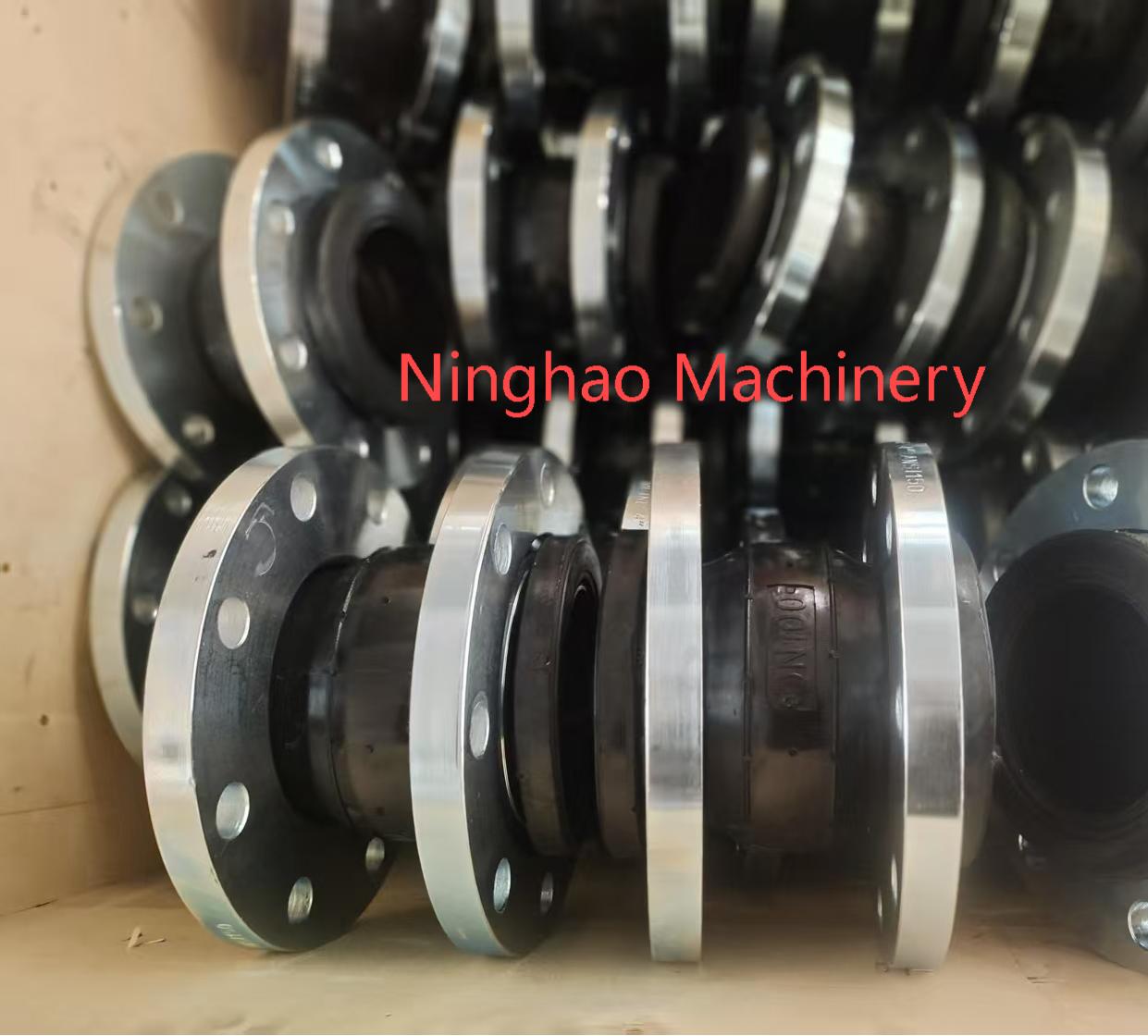
A significant percentage of elastomer failures stem directly from installation errors. They rarely result from actual manufacturing defects. Field technicians must treat every pipe expansion joint with precision. Hasty installation techniques ruin perfectly engineered products.
Control units, often called tie rods, manage pressure thrust forces. When fluids flow under pressure, they exert immense force against the pipe walls. This force actively pushes unanchored pipe sections apart. The expansion joint will elongate to absorb this separation.
Control rods are strictly non-negotiable in unanchored piping systems. They physically prevent the joint from over-elongating. If the joint stretches beyond its maximum rated extension, the arch will tear. Control units absorb the thrust force, protecting the rubber body from catastrophic blowout.
Mating flange selection directly impacts the rubber seal. You must address the risk of cutting the rubber flange face. Serrated flanges or raised-face flanges act like knives against elastomer. When you tighten the bolts, a raised face digs into the rubber bead.
We mandate the requirement for flat-face mating flanges. If your system already has raised-face flanges, you must use specific metal retaining rings. These rings distribute the bolting pressure evenly. They protect the rubber from localized crushing and tearing.
Bolting up the joint requires disciplined technique. Technicians must use a calibrated torque wrench. The necessity of a star-pattern torquing sequence is absolute. You must tighten bolts incrementally across opposite sides.
Over-torquing is a massive danger. Excessive bolt pressure crushes the elastomer matrix. It breaks the internal reinforcing fabric. Never exceed the manufacturer's recommended torque values. A crushed flange will leak immediately upon system pressurization.
Procurement teams must apply strict shortlisting logic. You need to differentiate between simple commodity distributors and true manufacturing partners. An engineered piping system demands direct collaboration with an expert.
A reliable OEM rubber connector manufacturer offers deep custom fabrication capabilities. Facilities frequently face non-standard replacement lengths. You may encounter offset flanges due to structural shifting. Your partner must supply specialized flange drillings, including ANSI, DIN, or JIS standards.
Advanced manufacturers also provide specialized tube and cover combinations. You might need an EPDM internal tube matched with a specific exterior. Options include high-visibility covers or fire-retardant exterior layers. True manufacturers adapt their tooling to meet these complex requests.
Quality assurance separates exceptional suppliers from average ones. You must look for strict compliance with Fluid Sealing Association (FSA) standards. Request documentation detailing their hydrostatic pressure testing protocols. Material traceability reports ensure the EPDM batch meets chemical specifications.
We advise procurement and engineering teams to prepare thoroughly. You must draft a complete data sheet before contacting the OEM for a quote. Your specification sheet must accurately list the fluid media. It must include exact temperature and pressure maximums. Document the anticipated system movements and exact pipe sizes. Providing this precise data guarantees an accurate, safe product match.
Finalizing the specification for an EPDM rubber expansion joint requires strict engineering discipline. You must ensure absolute adherence to fluid compatibility guidelines. Navigating temperature thresholds and movement calculations prevents premature field failures. Overlooking any single variable compromises your entire piping network.
We offer a vital final recommendation. Do not treat expansion joints as standard, disposable pipe fittings. You must treat them as highly engineered mechanical components. Partner exclusively with manufacturers who provide transparent pressure-temperature derating curves. Their engineering data proves their product reliability.
We prompt you to consult your system schematics today. Gather your precise operating parameters. Reach out to expert technical sales engineers with a fully completed specification sheet. Proactive evaluation secures your facility against unexpected downtime.
A: Typically 212°F to 250°F (100°C to 120°C), depending on the fabric reinforcement (e.g., nylon vs. Kevlar) and manufacturer specifications. Operating at the absolute maximum temperature requires derating the allowable system pressure to prevent joint rupture.
A: No. EPDM degrades rapidly in the presence of petroleum-based fluids. The rubber will swell and lose structural integrity. Nitrile (Buna-N) or Viton should be specified instead for any hydrocarbon service.
A: Whenever the piping system is not fully anchored to handle pressure thrust forces, or when there is a risk of the system pressure exceeding the joint's movement limits. They physically prevent the joint from tearing apart.
A: Floating flanges (common on spherical joints) rotate freely, making bolt-hole alignment easier during installation, whereas fixed integral flanges (spool type) provide a robust, full-face rubber seal integrated directly into the body.