- All
- Product Name
- Product Keyword
- Product Model
- Product Summary
- Product Description
- Multi Field Search

Views: 177 Author: Site Editor Publish Time: 2026-08-10 Origin: Site


Pipeline systems operating under high stress, thermal variation, and mechanical vibration require reliable compensation to prevent premature component failure. Left unchecked, these dynamic forces can easily fracture rigid piping infrastructure and damage surrounding equipment. While standard compensators exist, specifying the correct connection involves navigating precise material compatibilities, complex movement allowances, and strict installation constraints. Industrial engineers face constant pressure to balance fluid flow efficiency against the severe risk of catastrophic system leaks. Choosing improper materials or incorrect structural configurations often leads to costly facility downtime and hazardous environmental spills. This project note outlines the technical evaluation criteria, implementation risks, and procurement logic required to select and source the right joint for heavy-duty piping applications. You will learn how to accurately match elastomers to your system media, calculate safe operational thresholds, and completely avoid the most common installation pitfalls.
Configuration matters: Selecting between single-sphere and a double ball rubber joint dictates allowable axial and lateral movement.
Material dictates lifespan: Elastomer selection (EPDM, Nitrile, PTFE-lined) must strictly align with the system's media, temperature, and pressure constraints.
Installation risk is high: Improper flange mating (e.g., matching to raised-face flanges without support) or incorrect torque sequences are the primary causes of early joint failure.
OEM vetting is critical: Custom applications require an OEM flanged rubber joint partner capable of providing verifiable hydro-testing and material certifications.
Piping networks continuously battle variable operational stresses in industrial environments. You must account for massive thermal expansion, aggressive pump vibration, and inevitable ground settlement. Unmitigated, these mechanical stresses rapidly destroy costly pumps, precision valves, and rigid structural anchors. We frame this business problem around equipment longevity and operational safety. Facility managers cannot afford unexpected shutdowns caused by sheer stress fractures in metal piping.
We evaluate success through clear, measurable mechanical criteria. A correctly specified flanged flexible joint absorbs directional movement effectively across multiple axes. It isolates damaging mechanical noise and harmonic vibration originating from heavy machinery. Furthermore, it maintains a drop-tight seal under fluctuating pressures without over-stressing the adjacent pipework. Achieving this balance requires precise engineering calculations.
Engineers constantly weigh rubber materials against metal bellows alternatives. Rubber provides far superior vibration dampening capabilities. It offers a significantly lighter weight, which eases handling during installation. Elastomer solutions also require much shorter face-to-face installation space. They naturally resist severe corrosion and slurry abrasion far better than many untreated metal alloys.
However, distinct physical limitations exist. Rubber exhibits lower maximum temperature thresholds compared to stainless steel metal bellows. It remains highly susceptible to UV rays and atmospheric ozone degradation if manufacturers formulate the chemical compound incorrectly.
Evaluation Criteria | Rubber Expansion Joints | Metal Bellows Joints |
|---|---|---|
Vibration Dampening | Excellent (absorbs harmonic frequencies) | Poor (transmits noise and vibration) |
Corrosion & Abrasion | High resistance (especially against slurries) | Susceptible to chemical attack unless lined |
Temperature Limits | Generally up to 250°F - 400°F (depends on elastomer) | Can exceed 1000°F safely |
Installation Space | Compact face-to-face dimensions | Requires longer installation footprints |
Fatigue Life | High elasticity ensures longer cycle life | Subject to metal fatigue and work hardening |
The internal architecture of a pipeline rubber compensator directly dictates its field performance and longevity. You cannot judge these components by their exterior appearance alone. We break this down into three critical structural layers, each serving a distinct engineering purpose.
The Tube (Inner Layer): This seamless internal layer makes direct contact with the flowing media. It must be perfectly chemically compatible with the internal fluids. Whether you transport abrasive slurries, highly concentrated acids, or clean potable water, the inner tube prevents media penetration into the structural carcass.
The Carcass (Middle Layer): This section provides the primary structural strength. It consists of high-quality fabric and metal reinforcements. Manufacturers utilize nylon, polyester, or embedded steel wire to dictate the overall pressure ratings. The carcass prevents the joint from expanding like a balloon under high internal pressure.
The Cover (Outer Layer): The exterior layer protects the internal carcass from hostile environmental factors. It defends against atmospheric ozone, severe weather conditions, UV exposure, and external chemical splashes. A compromised cover eventually leads to carcass failure.
Next, you must evaluate the geometric arch design. A single arch configuration serves as the standard choice for typical pump vibration and minor pipeline movement. It provides excellent stability for general industrial applications. Conversely, extreme operational shifts demand a double ball rubber joint. This dual-sphere configuration accommodates significantly greater axial elongation, axial compression, and lateral deflection. It achieves this superior flexibility without increasing the overall flange footprint, making it ideal for cramped mechanical rooms.
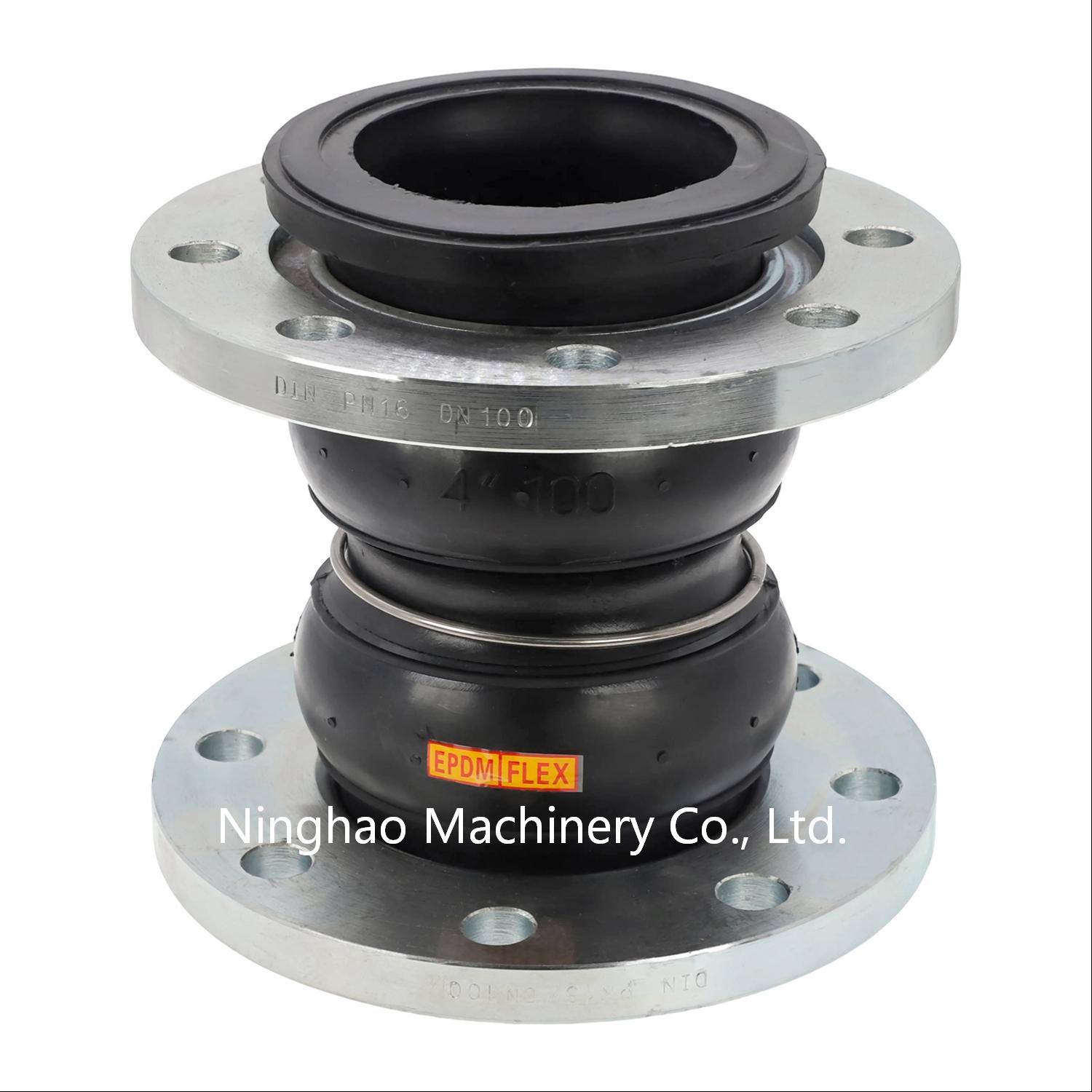
Matching your internal fluid media to the correct elastomer prevents rapid chemical breakdown. If you select the wrong rubber compound, the inner tube will swell, blister, or dissolve entirely. EPDM stands out as the ideal choice for cooling water, municipal wastewater, and mild alkaline chemicals. Nitrile (commonly known as Buna-N) remains strictly necessary for crude oil, petrochemicals, and general hydrocarbon transport. Neoprene provides a versatile middle ground. It resists external weathering brilliantly while offering moderate internal chemical resistance to oils and ozone.
You must carefully calculate operational Pressure and Temperature (P/T) ratings. Never look at peak design pressure and peak design temperature in isolated silos. High heat physically softens elastomer compounds. Therefore, you must evaluate the de-rated pressure capacity at the system's maximum operating temperature. A joint rated for 150 PSI at ambient temperature might only safely hold 80 PSI at 200°F. Ignoring this critical de-rating principle frequently causes catastrophic blowout failures.
Flange standards require meticulous matching before procurement. Ensure your specified drilling patterns align perfectly with your existing pipework. Common global standards include ANSI/ASME B16.5, DIN, and JIS. Furthermore, always specify high-quality retaining rings. These split steel rings sit behind the rubber flange. They distribute bolting compression evenly across the rubber face, preventing the bolts from tearing through the elastomer material.
Installation errors destroy flexible connections much faster than standard operational wear. Even the most robustly engineered joint will fail immediately if installed incorrectly. Rubber joints are explicitly designed to mate flush with flat-face flanges. Mating them directly to a raised-face flange creates a severe pinch point. This structural mismatch easily cuts or crushes the internal rubber bead during the bolting process. If you must connect to a raised-face flange, you need to install a supportive spacer ring.
Torque sequencing demands strict adherence to engineering protocols. Technicians must tighten flange bolts using a strictly alternating star pattern. This cross-bolting approach prevents uneven compression and subsequent media leakage. You should apply torque in gradual increments, checking the gap continually. Overtightening damages the elastomer permanently. Once you crush the rubber matrix, it loses its elasticity and sealing properties forever.
Control units, commonly called tie rods or limit rods, serve a massive safety function. Explain the critical necessity of control rods in unanchored piping networks. Unanchored systems require control rods to manage immense pressure thrust forces. They physically prevent the joint from over-elongating. Without them, sudden pressure spikes push the adjacent pipes apart, causing an immediate and highly dangerous blowout failure.
Pre-installation checks act as your final safety net on the job site. Always enforce the following protocol:
Verify all face-to-face gap dimensions perfectly match the relaxed joint length.
Never physically stretch or compress the rubber joint to bridge an improper pipe gap.
Inspect all adjoining internal pipe edges for sharp burrs, rough weld spatter, or gouges.
Ensure all adjoining pipes are properly supported by structural anchors and alignment guides.
Check the elastomer interior for any foreign debris before lifting it into place.
Industrial procurement requires careful and methodical vendor vetting. Standard off-the-shelf options rarely fit complex, high-pressure industrial applications perfectly. You must evaluate manufacturers heavily on their bespoke engineering capabilities. Assess their precise ability to produce an OEM flanged rubber joint tailored to your specific length, pressure rating, or multi-directional movement requirements. True engineering expertise matters immensely when customizing a flanged rubber expansion joint for high-stakes processing environments.
Prioritize strict compliance and deep manufacturing traceability. You cannot rely on visual inspections to guarantee material integrity. Shortlist manufacturing partners who deliver strictly FSA (Fluid Sealing Association) compliant designs. Demand full Material Test Reports (MTRs) to guarantee raw material batch traceability. Furthermore, require documented factory pressure testing before shipment. Specifically, ask for certified hydro-testing reports. Hydro-testing proves the joint can withstand operational pressures before it ever reaches your facility floor.
Specifying a highly reliable piping connection requires balancing precise elastomer chemistry, accurate thermal movement calculations, and strict adherence to field installation protocols. Overlooking any single operational variable easily compromises the integrity of your entire piping network. Project engineering teams should immediately audit their current piping stress analysis data to identify vulnerable anchor points. Define your exact fluid media, concentration levels, and temperature parameters clearly before contacting suppliers. Finally, consult directly with a qualified manufacturing partner to request detailed performance data sheets and structural CAD drawings for your specific application.
A: No. The integrated rubber flange acts as its own high-performance gasket. Adding an additional external gasket can cause uneven seating, localized stress points, and eventual system leaks. Always bolt the rubber face directly against the adjoining flat-face pipe flange.
A: Standard elastomer joints can handle mild vacuum pressures effectively. However, deep vacuum applications require internal vacuum rings made from solid stainless steel. These structural rings physically prevent the internal rubber tube from collapsing inward under severe negative pressure.
A: Visual inspections should be conducted at least annually. Look closely for warning signs of surface cracking, exterior blistering, fluid weeping, or any exposure of the internal reinforcing fabric. Overall lifespan remains highly dependent on your specific operating pressures, fluid temperatures, and environmental conditions.