- All
- Product Name
- Product Keyword
- Product Model
- Product Summary
- Product Description
- Multi Field Search

Views: 0 Author: Site Editor Publish Time: 2026-09-09 Origin: Site


Elastomeric joints excel at absorbing vibration and accommodating piping misalignment in complex industrial systems. Exposing them to negative pressure introduces severe risks of structural collapse. Standard off-the-shelf elastomeric joints primarily handle positive pressure environments. Applying them to pump suction lines or vacuum environments without proper specification leads to rapid system failure. You cannot rely on standard positive-pressure ratings to predict negative pressure performance. A rubber expansion joint can operate securely under vacuum conditions. However, you must engineer it using specific structural reinforcements and appropriate arch profiles. It also requires strict adherence to pressure-temperature derating guidelines. In this article, you will learn the exact mechanics of negative pressure on flexible elastomers. We will explore necessary internal structural supports and evaluate different joint configurations. You will discover how to specify the correct components to prevent implosion and maintain critical system integrity.
Vacuum environments create a massive inward pressure differential across the elastomer body. Atmospheric pressure pushes aggressively against the exterior shell. Simultaneously, internal pressure drops below standard atmospheric levels. This forces unreinforced rubber arches to invert inward toward the fluid stream. Flow becomes restricted immediately as the arch collapses into the pipe cavity. Eventually, the internal rubber layers stretch beyond their yield point. They tear, causing a complete breach of the piping system.
Many engineers mistakenly assume high positive pressure ratings equal high vacuum tolerance. This assumption proves dangerous in practice. An expansion joint rated for 150 PSI positive pressure cannot inherently handle a full vacuum of 29.9 inHg. Positive pressure inflates the joint outward. This puts the internal nylon or Kevlar fabric reinforcement layers under beneficial tension. Negative pressure does the exact opposite. It pushes the fabric inward. Fabric layers offer zero structural support against compressive inward forces. The elastomer matrix must bear the entire atmospheric load alone.
Real-world implementations often fail due to this fundamental oversight. Pump cavitation frequently causes unexpected vacuum spikes on suction lines. A blocked upstream strainer can suddenly drop internal pressure. Rapidly closing valves also generate transient negative pressure waves. The unsupported rubber instantly collapses under these conditions. The component destroys itself, halting operations and causing expensive fluid spills.
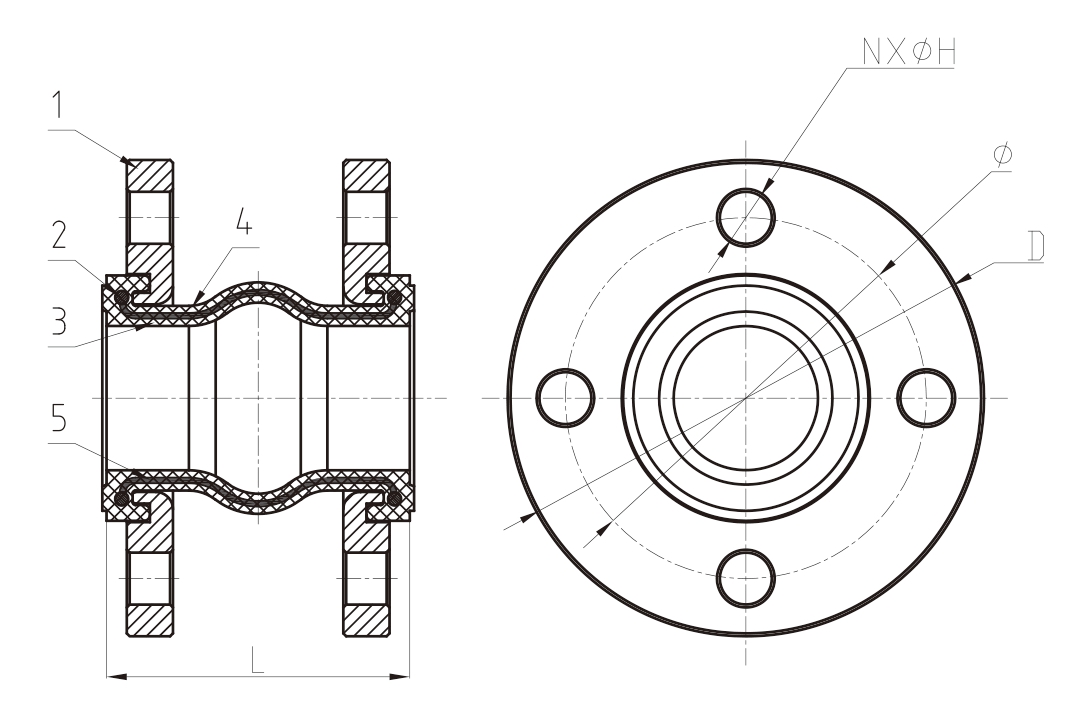
You must structurally reinforce the joint to counteract atmospheric crushing forces. Internal vacuum rings serve as the primary mechanical defense against arch implosion. Manufacturers embed metallic wire or solid steel root rings directly into the rubber matrix during vulcanization. Certain high-vacuum designs utilize external rings nested deeply within the root of the arch. You must select the right material for these rings based on the surrounding environment. Standard carbon steel works well for basic chilled water lines. Corrosive media require stainless steel or specialized alloys. Proper material selection ensures longevity and prevents hidden structural degradation inside the rubber casing.
Arch profile plays a massive role in negative pressure tolerance. A single ball rubber expansion joint inherently resists arch collapse better under moderate vacuum conditions. It features a lower arch profile and a shorter face-to-face dimension. The shorter geometric span gives the rubber less room to fold inward. The flanges sit closer together, providing rigid support to the elastomer body.
Conversely, a double sphere rubber expansion joint poses higher risks in suction applications. The extended mid-section lacks direct steel flange support. This creates extreme vulnerability under vacuum conditions. The two arches will easily collapse inward toward each other when internal pressure drops. You must specify specialized mid-section root rings to prevent this inward folding. Without robust mid-section reinforcement, the double sphere design will fail rapidly under negative pressure.
Industrial applications vary wildly in scale and vacuum intensity. Large-diameter industrial suction lines demand heavily engineered solutions. Heavy-duty water treatment plants often generate severe vibration alongside continuous full vacuum. Dredge pumps and cooling towers share similar harsh operating dynamics. You need flanged, custom-built elastomeric joints for these sectors. These units feature heavy-duty built-in steel reinforcing rings. A successful large-diameter installation withstands a full vacuum of 29.9 inHg continuously. It absorbs heavy mechanical vibration from industrial pumps without fatiguing the rubber. The embedded rings remain perfectly stable.
Small-diameter and light-duty applications require different procurement considerations. A union rubber expansion joint works well for simple positive pressure isolation. You see them frequently in residential HVAC networks or light commercial plumbing. They carry severe limitations regarding negative pressure. Threaded union joints rarely carry official ratings for high vacuum conditions. The mechanical grip of the threaded union can fail if the rubber pulls inward aggressively.
You must establish clear shortlisting logic for your projects. When vacuum depth exceeds minor partial vacuum, transition away from union joints. Specify a flanged, internally reinforced joint instead. Flanges provide a secure, 360-degree mechanical bite on the rubber bead. This rigid perimeter prevents the joint from pulling out of its fittings. The flanged connection easily counteracts atmospheric pressure pushing inward.
Specifying vacuum-rated joints requires looking beyond static baseline ratings. Temperature heavily influences elastomeric stiffness. Rubber softens significantly as system temperature rises. A joint rated for full vacuum at ambient 70°F (21°C) may fail completely at 180°F (82°C). You must apply strict temperature-pressure derating factors during specification. Fluid Sealing Association (FSA) guidelines strongly recommend consulting derating charts before finalizing any high-temperature suction application.
Baseline Vacuum Derating by Operating Temperature
| Operating Temperature (°F) | Operating Temperature (°C) | Vacuum Rating Modifier (%) | Operational Risk Level |
|---|---|---|---|
| Up to 85°F | Up to 29°C | 100% (No derating required) | Low Risk |
| 86°F - 130°F | 30°C - 54°C | 85% of baseline rating | Moderate Risk |
| 131°F - 170°F | 55°C - 76°C | 70% of baseline rating | High Risk |
| Above 170°F | Above 76°C | Requires Custom Engineering | Critical Risk |
Media compatibility also dictates vacuum survival. Chemical degradation drastically reduces negative pressure tolerance. Hydrocarbons actively attack EPDM rubber. This chemical reaction causes the elastomer to swell and soften. Swelling degrades the structural integrity of the entire arch. A chemically weakened joint will implode under a fraction of its rated vacuum. You must verify elastomer compatibility against the exact fluid being conveyed. Use NBR (Nitrile) for oils and PTFE-lined joints for harsh acids.
Finally, rely exclusively on strict compliance and certification data. Never depend on assumed safety factors. Request verifiable manufacturer testing data confirming specific vacuum ratings. Look for documented burst and implosion test results. Quality manufacturers provide specific engineering charts. These charts detail negative pressure capabilities across different temperatures and profiles.
Even the best-engineered joint fails quickly if installed incorrectly. Proper piping alignment stands as an absolute non-negotiable requirement. Vacuum-rated joints must go into precisely aligned piping systems. Using the joint to correct severe misalignment pre-stresses the rubber. This uneven tension lowers its vacuum resistance significantly. Atmospheric pressure will violently exploit the weakest, most stretched section of the arch.
Control units require careful evaluation before commissioning. Engineers frequently use tie rods to prevent over-extension under positive pressure. Standard tie rods do not prevent compression or collapse under vacuum. You must evaluate the need for specialized compression sleeves. Compression sleeves sit over the tie rods between the flange plates. They physically stop the flanges from pulling too close together. This limits the compression stroke when the pipe experiences deep vacuum.
Implement a skeptical, evidence-based maintenance schedule. Visual inspections save critical systems from catastrophic failure. Focus your inspection protocols on these specific areas:
Deploying a flexible elastomer joint in a vacuum is entirely viable. It requires explicit specification for negative pressure environments. You must mandate appropriate internal rings to reinforce the structure. Selecting the correct arch profile prevents inward folding. Standard positive-pressure units simply cannot survive atmospheric crushing forces. You must engineer the component to match the exact system physics.
Take immediate action to secure your piping networks. Calculate the exact vacuum depth your system experiences daily. Differentiate clearly between minor partial vacuum and continuous full vacuum. Verify your peak operating temperatures to apply accurate derating factors. Consult directly with manufacturers to specify reinforced single ball configurations for maximum stability. If your application demands greater movement, explicitly engineer double sphere configurations using robust mid-section support rings.
A: No. Standard joints will collapse under full vacuum (29.9 inHg). They require internal vacuum rings to withstand the inward atmospheric pressure.
A: A single ball is generally more stable under negative pressure natively, whereas a double sphere requires robust mid-section reinforcement to prevent implosion.
A: Yes, pump suction lines often experience vacuum conditions, particularly during startup or if blockages occur; rings act as a critical fail-safe to prevent collapse.
A: Typically no. Union connections are meant for smaller, positive-pressure systems. Vacuum applications usually require reinforced, flanged connections to ensure a rigid, leak-proof seal.