- All
- Product Name
- Product Keyword
- Product Model
- Product Summary
- Product Description
- Multi Field Search

Views: 0 Author: Site Editor Publish Time: 2026-09-30 Origin: Site


Installing flexible joints in vertical piping configurations introduces unique gravitational and fluid-dynamic challenges. These specific challenges do not usually exist in standard horizontal setups. While the primary function of the joint remains the same, your installation approach must change. Vertical integration requires strict adherence to structural support parameters. You must absorb vibration, manage thermal expansion, and correct misalignment without compromising the pipe's integrity. These systems demand precise engineering to function safely over decades of continuous use.
Yes, a rubber flexible joint can be installed in vertical piping safely. You simply need to guarantee the system relies on independent anchoring. External control units must bear the piping's weight rather than the joint itself. By separating the structural load from the flexibility component, you ensure systemic longevity. You will learn the exact physical requirements and configuration strategies below. We will also explore the strict implementation controls needed to prevent catastrophic mechanical failures.
Gravity creates a massive downward force in any vertical piping stack. Fluid weight and pipe mass press heavily against the lowest components. This creates a constant compressive force on the expansion joint. In a horizontal setup, the ground or base supports the pipe weight uniformly. In a vertical run, the fluid column creates hydrostatic head pressure. This pressure pushes downward relentlessly. Left unchecked, the joint bears loads it was never engineered to handle. Water weighs roughly 62.4 pounds per cubic foot. A tall vertical pipe holds thousands of pounds of fluid. Gravity constantly pulls this mass downward.
We must define clear success criteria for vertical installations. The piping system must independently handle all structural loads. We use mechanical hangers, rigid anchors, and alignment guides for this exact purpose. The joint strictly manages movement and vibration absorption. It acts as a shock absorber, not a load-bearing column. When you separate these structural duties, the system thrives. Hangers carry the static pipe weight. Anchors direct the thermal expansion forces. The rubber material simply flexes to accommodate the resulting shifts.
Mechanical failure happens quickly without proper support. You might observe bulging, tearing, or sudden flange separation. The joint succumbs to the unmitigated downward force of the vertical pipe run. Over-compression destroys the internal reinforcing fabric. The rubber arches invert or collapse entirely. Once the internal fabric tears, a blowout becomes inevitable.
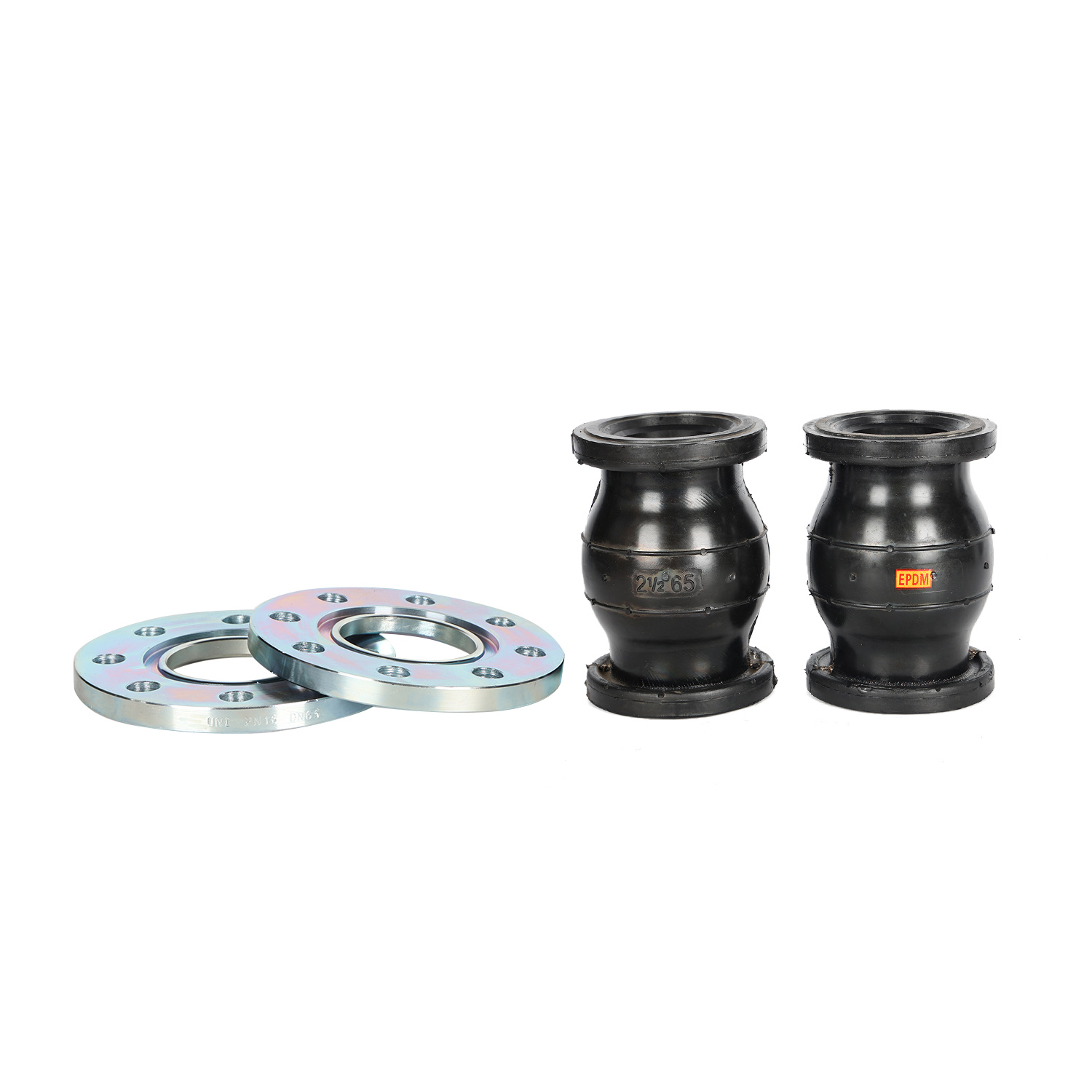
Engineers often prefer a single ball rubber flexible joint for standard vertical runs. We evaluate this design as the best option for moderate vibration isolation. It provides minimal lateral movement, which keeps the vertical stack aligned. The primary advantage is its higher structural stability. It resists lateral squirm much better than its multi-sphere counterparts. However, you face a minor limitation in allowable axial compression. It cannot compress as deeply as longer joints. For standard HVAC chilled water risers, this configuration works perfectly.
Sometimes you need aggressive noise reduction. You might also face significant thermal expansion in tall vertical shafts. Here, a double sphere rubber flexible joint becomes ideal. We evaluate it highly for acoustic dampening. The dual arches trap sound waves effectively. However, vertical risks increase significantly. This design is highly susceptible to sagging. It experiences severe lateral squirm in vertical orientations without rigid guiding. The middle section tends to buckle outward under downward pressure. You must install strict pipe guides to keep this joint perfectly centered.
For smaller diameter lines, you will typically use a threaded rubber flexible joint. We evaluate these for localized plumbing and compact HVAC systems. They handle high-frequency vibrations from small circulating pumps. Implementation requires careful attention to detail. You must apply precise threading torque. Installers must use proper unions to prevent stripping under vertical load stress. If you overtighten the threads, you risk cracking the brass or steel fittings. If the vertical pipe shifts, stripped threads will cause immediate leaks.
Limit rods are strictly mandatory in all vertical installations. They restrict excessive elongation. More importantly, they prevent dangerous over-compression caused by gravity. Hydrostatic pressure fluctuates when pumps turn on and off. These fluctuations cause the joint to stretch and squash rapidly. Tie rods act as the ultimate physical boundary. Gusset plates must sit perfectly flush against the mating flanges. Torque specifications require exact measurement during the initial setup. You must leave the correct gap on the tie rod nuts. This gap allows normal thermal expansion but stops catastrophic collapse.
You cannot install a vertical joint without a comprehensive anchoring strategy. Main anchors must go immediately above and below the unit. They isolate the vertical section completely. The anchor below carries the downward thrust. The anchor above holds the static weight of the rising pipe. Pipe guides stop lateral deflection, commonly known as squirm. Vertical fluid flow exacerbates this deflection. Fluid rushing downward creates turbulent kinetic energy. Guides keep the pipe moving strictly along its axial centerline.
We must issue an explicit warning regarding equipment weight. The flexible joint must never support the weight of the pump. It must not hold valve weight. It cannot support the vertical pipe stack under any circumstances. This rule remains absolute across all piping frameworks. When you force rubber to act as steel, it fails. Structural piping engineers mandate independent supports for every heavy component. You must hang valves from the ceiling or support them from the floor. The rubber piece simply slides into the gap between securely anchored pipes.
You must assess the elastomer material based on the internal fluid. We commonly validate EPDM, Nitrile, or Neoprene. The fluid’s specific gravity impacts the overall vertical load. Heavier fluids increase the hydrostatic head pressure linearly. EPDM handles hot water and standard HVAC fluids brilliantly. Nitrile resists oils and petroleum products that might degrade standard rubber. Neoprene provides excellent external weathering resistance if the vertical pipe runs outdoors. Material selection dictates how long the unit survives under constant vertical strain.
Calculating the required pressure rating takes careful math. You must factor in the vertical hydrostatic head pressure. A pump at the basement level pushes water up 20 stories. The joint at the bottom experiences the pump's discharge pressure plus the weight of the entire water column above it. Thrust forces multiply exponentially in these scenarios. You must calculate the effective area of the joint. Multiply this area by the maximum system pressure. The resulting number is the thrust force pushing outward and downward. Your anchors must withstand this exact force.
Industry standards keep commercial buildings safe. Look for AWWA (American Water Works Association) or ASME compliance. These specific industry certifications validate the unit's burst pressure. They prove tensile strength under directional loads. ASME B31.9 (Building Services Piping) outlines clear rules for expansion joint integration. Reputable manufacturers test their products to meet or exceed these standards. Never install an uncertified joint in a critical vertical stack.
Always maintain a healthy skepticism during procurement. Avoid manufacturers who claim their rubber products require no external support in vertical applications. Physics applies universally. Rubber always requires structural assistance when fighting gravity. If a sales representative tells you that tie rods are optional for a 10-inch vertical water main, walk away. Prioritize vendors who supply comprehensive engineering data over those offering magical, unsupported solutions.
The following chart outlines how different elastomers handle varying system demands in vertical setups.
| Elastomer Type | Ideal Fluid Application | Temperature Resistance | Vertical Load Resilience |
|---|---|---|---|
| EPDM | Chilled/Hot Water, Steam | Excellent (Up to 250°F) | High structural integrity against water column weight. |
| Nitrile (Buna-N) | Oils, Petroleum, Fuels | Good (Up to 212°F) | Moderate; requires strict guiding to prevent oil-induced softening. |
| Neoprene | Wastewater, Mild Chemicals | Good (Up to 225°F) | Excellent; provides tough exterior resistance for exposed outdoor risers. |
Before buying anything, check your existing anchor points. Assess all structural supports carefully before procurement. Old hangers might be degraded or heavily rusted. If your current vertical pipe sways when you push it, your anchors are failing. You must fix the structural steel before introducing a flexible rubber element. Conduct a full visual inspection of the vertical stack. Identify where the static weight currently rests. Map out exactly where the new main anchors will go.
Demand transparency from your suppliers. Ask them for specific vertical installation manuals. Request thrust force calculation charts for your exact pipe diameter. Demand comprehensive control rod schematics. A reliable manufacturer will eagerly provide this engineering data. They understand that proper installation protects their product's reputation. Review these documents alongside your facility's piping blueprints. Ensure the manufacturer's maximum allowable compression limits align with your calculated thermal expansion metrics.
Installing a rubber expansion joint vertically is highly feasible, but it remains unforgiving of poor structural engineering. Gravity and hydrostatic head pressure constantly test the system's mechanical limits. By separating the load-bearing duties from the vibration-absorbing duties, you guarantee a safe environment. The rubber must only handle movement, never static weight.
We recommend ensuring that your system design prioritizes absolute weight offloading. You must enforce mandatory control rod utilization across all vertical risers. Do not cut corners on pipe guides or main anchors. The initial effort required to secure the pipe prevents catastrophic floods and mechanical blowouts down the line.
Consult with a certified structural piping engineer today. Request a technical sizing review from a qualified manufacturer before finalizing any purchase. Proper planning now ensures decades of leak-free, quiet operation.
A: Yes. Even short vertical runs generate hydrostatic thrust and pump vibrations that can exceed the joint's mechanical limits over time. Control rods act as fail-safes. They prevent sudden over-compression or hyper-extension during unexpected pressure surges.
A: Standard rubber expansion joints are typically bi-directional, but downward flow increases pressure surges at the lowest point. Verification of pressure ratings against the system's maximum surge is required. Always account for gravity accelerating the fluid downward.
A: No. Neither joint is designed to bear weight. A double sphere actually requires more stringent guiding because its increased flexibility makes it more prone to lateral buckling under vertical stress. Both require independent anchoring.
A: Lack of proper anchoring. When pipes settle or structural supports fail, the total weight transfers to the rubber joint, leading to immediate over-compression and catastrophic rupture. The internal fabric tears under the unexpected vertical load.