- All
- Product Name
- Product Keyword
- Product Model
- Product Summary
- Product Description
- Multi Field Search

Views: 0 Author: Site Editor Publish Time: 2026-09-16 Origin: Site


Industrial piping systems rely on exacting precision to operate safely under immense pressure and thermal stress. When engineers specify components, getting the dimensions right is not just a preference; it is absolutely mandatory. Specifying incorrect face-to-face lengths—also known as Overall Length or OAL—remains a primary cause of premature piping system failure. These dimensional errors routinely trigger costly installation delays and invalidate manufacturer warranties. Forcing mismatched components into a rigid system pre-stresses the elastomer before it ever sees active duty. Accurate specification serves as the absolute baseline for operational safety. It ensures effective vibration isolation and dictates long-term system longevity. This guide breaks down the critical elements of joint measurement and selection. You will learn the technical framework for verifying, calculating, and ordering the correct length based on strict industry standards. We will also explore how distinct system movement requirements dictate your configuration choices to keep critical operations running smoothly.
Face-to-face length, often designated as Overall Length (OAL), serves as a fundamental engineering metric. It represents the precise distance between the outer sealing faces of the joint’s flanges. You must measure this dimension when the unit rests in a completely neutral, uninstalled state. Engineers cannot measure it accurately while the unit sits compressed or elongated under pipe tension. This baseline measurement dictates how the component will behave once pressurized.
When working with elastomer products, conventional gasket rules change significantly. Full-face rubber flanges typically act as their own gaskets. The soft rubber face compresses against the mating metal pipe flange to create a secure seal. Specifiers must calculate the exact pipe gap directly from flange face to flange face. You should not add external gasket thickness tolerances to this equation. Adding extra gasket width calculations leads to improper sizing and creates unintended compression during installation.
Installation reality often exposes critical flaws in initial system design. Engineers must enforce one golden rule across all job sites. You should never use an expansion component to compensate for poor pipe alignment. Fitters must not use them to bridge incorrect pipe gap lengths unless explicitly calculated as a predetermined "pre-set." Using elastomers to fix sloppy piping gaps leads to immediate mechanical stress. It introduces lateral shear forces. This drastically shortens the operational lifespan of the entire piping network.
Global industrial frameworks standardize how we measure and specify piping components. The Fluid Sealing Association (FSA) provides rigorous guidelines globally. Specifically, the Non-Metallic Expansion Joint Division sets standard length specifications. These standards ensure a baseline of predictability across different manufacturers and regions. They allow engineers to draft system layouts with confidence.
However, manufacturing elastomers differs vastly from machining steel. Rubber needs room to cure, cool, and settle. Therefore, natural dimensional tolerances exist in every batch. Typical acceptable manufacturing tolerances hover around ± 1/8 inch or ± 3mm. You must account for this slight variance during the installation planning phase. Minor discrepancies are normal, but they require careful handling during pipe fitting.
While standard face-to-face lengths often align, drilling patterns vary globally. ANSI, DIN, and JIS standards dictate distinct flange drilling layouts and bolt hole sizes. Interestingly, standard face-to-face lengths for equivalent nominal pipe sizes (NPS) often match across these distinct standards. However, specifiers must verify this meticulously per manufacturer data sheets. Assuming cross-standard compatibility without verification remains a common, costly engineering mistake.
Table: Standard Dimensional Tolerances for Elastomer Joints
| Nominal Pipe Size (NPS) | Typical Face-to-Face Length | Acceptable FSA Tolerance |
|---|---|---|
| 2" to 8" | 6.00 inches (152 mm) | ± 1/8 inch (3 mm) |
| 10" to 12" | 8.00 inches (203 mm) | ± 1/8 inch (3 mm) |
| 14" to 24" | 10.00 inches (254 mm) | ± 3/16 inch (5 mm) |
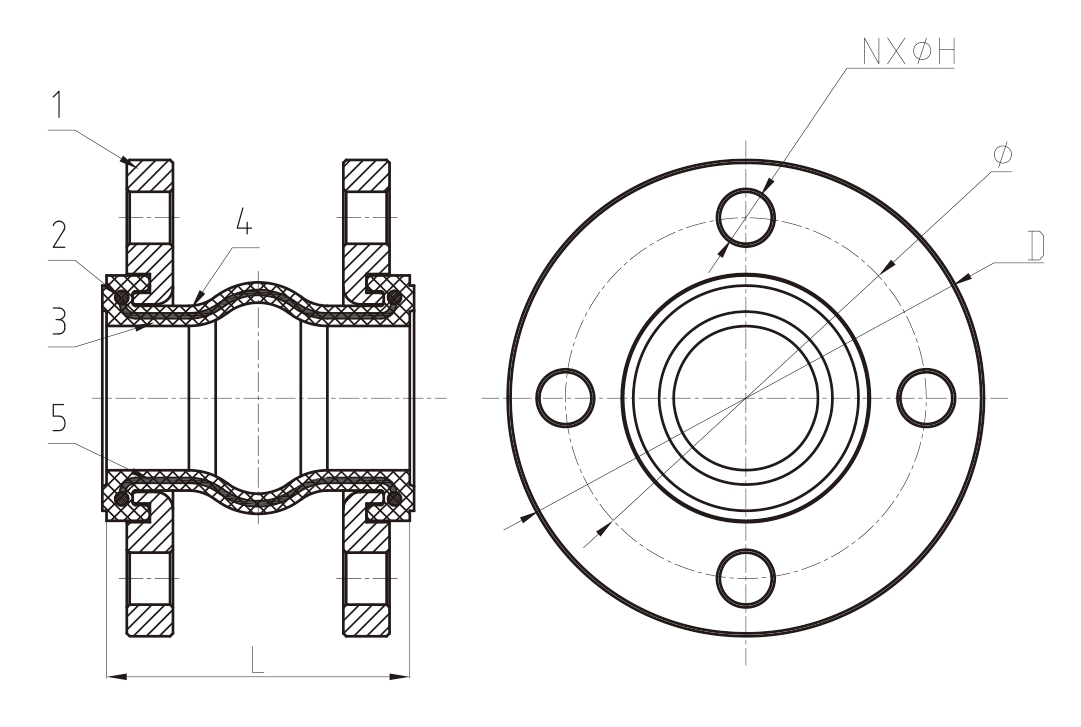
Different piping challenges require vastly different engineering configurations. The physical shape directly influences the required face-to-face length. System designers must balance available physical space against anticipated movement.
Consider the single ball rubber expansion joint. This popular design features a standard face-to-face length which runs typically shorter. For many standard pipe sizes, it averages right around 6 inches. This compact length provides excellent baseline axial compression and superior vibration isolation. It suits tight spaces perfectly, particularly near pump discharge lines where mechanical noise is high.
When systems experience dramatic physical shifts, engineers step up the design complexity. The double sphere rubber expansion joint handles far more structural stress. We must highlight the necessity of longer face-to-face lengths for these specific units. They accommodate much greater axial, lateral, and angular movements. You must frame the trade-off carefully. You need more physical space in the piping layout to gain that superior movement capacity. The dual arches require a longer body to distribute stress safely.
For smaller distribution lines, the approach shifts entirely. The union rubber expansion joint serves commercial HVAC and indoor plumbing applications beautifully. We differentiate the specification process here. These are smaller diameter, threaded units rather than flanged ones. Face-to-face is measured precisely from union-end to union-end. Highlighting their specific lengths helps HVAC engineers plan confined riser spaces accurately. Regardless of the specific layout, a correctly sized rubber expansion joint protects your costly infrastructure by absorbing kinetic energy.
Industrial piping systems are dynamic entities. Thermal expansion variables require precise mathematics to prevent catastrophic failure. Specifiers must calculate total pipe expansion and contraction accurately based on maximum temperature differentials. This math ensures the chosen face-to-face length features an adequate movement range. If a steel pipe heats up and grows by one inch, the connecting unit must compress safely by that exact amount without failing.
Sometimes, standard neutral installation is not sufficient for extreme temperature swings. This introduces the concept of the "pre-set" risk. Pre-setting represents an advanced implementation tactic. You might install the unit slightly extended initially. This specific setup allows for maximum compression later when the pipe eventually heats up to operating temperature. We must warn of the profound operational risks here. If you miscalculate the pre-set dimensions, the elastomer operates under constant, unnatural tension. This invites sudden ruptures and ply separations.
Furthermore, piping rarely moves in just one simple direction. Specifying length must actively account for concurrent movements. You routinely deal with simultaneous axial, lateral, and angular deflection. These mechanical forces combine rapidly during system surges. You must calculate the net movement to ensure you never exceed the elastomer’s designated yield point.
Chart: Thermal Movement Calculation Framework
| Movement Type | Impact on Face-to-Face Length | Calculation Consideration |
|---|---|---|
| Axial Compression | Shortens OAL | Calculate max pipe growth from thermal heat. |
| Axial Elongation | Lengthens OAL | Calculate max pipe shrinkage from chilling. |
| Lateral Deflection | Stresses arches unequally | Check combined movement limits per manufacturer specs. |
| Angular Deflection | Bends OAL off-axis | Ensure flanges do not pinch the rubber arch. |
Field execution errors frequently destroy excellent engineering designs. The "stretch-to-fit" fallacy is perhaps the most destructive installation habit. Detail the consequences of ordering a face-to-face length that is simply too short. Sometimes, rushed contractors instruct pipe fitters to physically stretch the unit to close the gap. This leads directly to immediate fabric ply tearing. It creates a massive blowout risk the very moment the system pressurizes.
Control unit mismanagement also ruins complex installations. Tie rods and limit bolts provide crucial safety redundancies. We clarify that they are set strictly based on the specified face-to-face length. Their primary job is to prevent catastrophic over-extension. Mis-specifying the base length renders these control units completely ineffective. They will either engage too late to prevent damage or restrict natural movement entirely.
Procurement introduces its own hidden hazards. Vendor substitution risks remain quite real in supply chains. We highlight the inherent danger of swapping one brand for another based on price alone. You must verify if their standard face-to-face dimensions are truly identical. A "six-inch" unit from Vendor A might actually measure 6.125 inches due to their specific molds. Vendor B might measure exactly 6.0 inches. That tiny fraction of an inch matters immensely during final flange tightening.
Before issuing a final purchase order, employ a strict shortlisting logic. Engineering and procurement teams should follow these steps meticulously to prevent field failures.
The next-step action is undeniably clear. We strongly advise procurement and engineering teams to communicate openly. Always cross-reference movement calculations with the manufacturer's submittal data. You must execute this step thoroughly before finalizing the purchase order (PO). Doing so proactively prevents dangerous and costly field adjustments later.
Face-to-face length remains an exact engineering specification rather than a flexible field guideline. Pinpoint dimensional measurement guarantees compliance, operational safety, and maximum system durability. Leaving these critical dimensions to guesswork directly invites catastrophic pipeline failures, leaks, and system downtime. Precision protects both personnel and equipment.
Moving forward, engineering teams must standardize their procurement audits. We highly encourage specifiers to consult directly with applications engineers early in the design phase. Validate your mathematical requirements with reputable manufacturers. Do this especially when designing custom layouts or highly dynamic fluid systems. Meticulous precision at the drawing board ensures perfect, lasting performance in the field.
A: Yes. While standard lengths exist (like 6", 8", 10"), manufacturers can produce custom-length joints via hand-built construction, though this increases lead times and costs compared to molded joints.
A: Measure flange face to flange face. However, recognize that if the system is under pressure or thermal load, the joint is likely compressed or elongated. Always reference the original design gap and system temperature at the time of measurement.
A: No. The face-to-face length of the rubber joint remains the same. Control rods are externally mounted and calibrated to allow movement within the limits of that specific length.