- All
- Product Name
- Product Keyword
- Product Model
- Product Summary
- Product Description
- Multi Field Search

Views: 0 Author: Site Editor Publish Time: 2026-09-02 Origin: Site


Industrial piping systems operate under immense dynamic stress every single day. Unmanaged thermal expansion, mechanical vibration, and foundation settlement introduce severe stress into piping systems, risking catastrophic failure, pump damage, and costly downtime. Specifying the correct rubber expansion joint prevents this by acting as a flexible isolating element.
However, selecting the right joint requires exact alignment between the system's anticipated dynamic stresses and the joint's movement absorption capabilities. This guide details the specific movement types these flexible connectors can handle effectively. We explore how different architectural designs impact overall capacity. You will also learn the evaluation criteria necessary for a secure, compliant installation.
Piping systems are rarely static entities. Fluid temperatures fluctuate constantly. Pumps induce high-frequency vibrations. Structural foundations settle over time. When you ignore these dynamic forces, the resulting stress transfers directly to the weakest points in your infrastructure.
Asset Protection
Pumps, chillers, and precision valves represent significant capital investments. When thermal growth expands a rigid steel pipe, it exerts massive thrust forces against these equipment flanges. Mechanical vibration also travels effortlessly through rigid connections. Isolating this vibration and accommodating thermal growth protects expensive adjacent equipment from flange stress and mechanical fatigue. A properly placed elastomeric connector absorbs this kinetic energy. It acts as a shock absorber. This prevents premature bearing wear and cracked pump casings.
System Longevity
Cyclical stress degrades pipe integrity over time. Repeated heating and cooling cycles fatigue the metal. Reducing structural noise and cyclical stress extends the overall lifecycle of the piping infrastructure. Acoustic dampening is a secondary but vital benefit. Rubber naturally breaks the sound transmission path. This creates a quieter, safer working environment for facility personnel.
Success Criteria
You cannot guess movement requirements. A successful specification relies on accurately calculating baseline thermal changes (ΔT) and mechanical tolerances to prevent premature joint failure or pipe blowout. Engineers must map the exact operational envelope.
To specify safely, you must understand exactly how elastomers respond to physical displacement. Industry standards outline five distinct dimensional changes. Four are beneficial. One is highly destructive.
Axial Compression
Definition: The reduction of the joint’s face-to-face dimension, typically caused by thermal expansion of the adjoining pipes pushing inward. As hot fluids flow through a system, metal pipes grow linearly. They push against the flexible connector.
Outcome: The joint absorbs linear growth without bowing the pipe. The elastomeric bellows bulge outward slightly to accommodate the shorter distance. This saves the pipe restraints from failing under extreme pressure thrusts.
Axial Extension (Elongation)
Definition: The increase of the face-to-face dimension, usually resulting from thermal contraction (cooling pipes pulling apart). Chilled water systems frequently experience this phenomenon. The metal shrinks, widening the gap between flanges.
Outcome: Prevents flange separation and tensile pipe failure. The bellows stretch inward, bridging the expanded gap while maintaining a secure, leak-proof seal.
Lateral Deflection
Definition: The relative displacement of the two flanges perpendicular to the longitudinal axis (shear movement). Picture two parallel flanges sliding slightly out of alignment vertically or horizontally.
Outcome: Accommodates foundation settlement or lateral wind/seismic sway. Large industrial tanks often settle unevenly over time. Lateral flexibility ensures the connecting pipes do not shear off at the tank wall.
Angular Movement
Definition: The bending of the joint where one flange ceases to be parallel to the other, measured in degrees. The centerline of the pipe essentially bends into an arc.
Outcome: Corrects for minor pipe misalignment and absorbs angular bending forces. It prevents point-loading on one side of the flange gasket. This keeps the seal intact during minor structural shifts.
Torsional Movement (The Exclusion)
Definition: Twisting along the longitudinal axis. Imagine grabbing both ends of a wet towel and twisting in opposite directions.
Risk: Rubber expansion joints are not designed to absorb torsion. Torsion shreds internal fabric reinforcement and voids warranties. The internal aramid or nylon cords lose their structural integrity instantly. Piping must be guided to prevent this rotational force entirely.
Table: Quick Reference Guide to Displacement Tolerances
| Movement Type | Primary Cause | Elastomer Response | System Benefit |
|---|---|---|---|
| Axial Compression | Thermal Heating | Bellows bulge outward | Prevents pipe buckling |
| Axial Extension | Thermal Cooling | Bellows stretch inward | Prevents tensile flange failure |
| Lateral Deflection | Foundation Settling | Parallel shear shift | Prevents shear fracture |
| Angular Deflection | Pipe Sagging | Bending arc | Maintains uneven gasket seal |
Not all flexible connectors offer the same range of motion. The physical geometry of the elastomer directly governs its mechanical limitations. Understanding these profiles helps you match the component to the application.
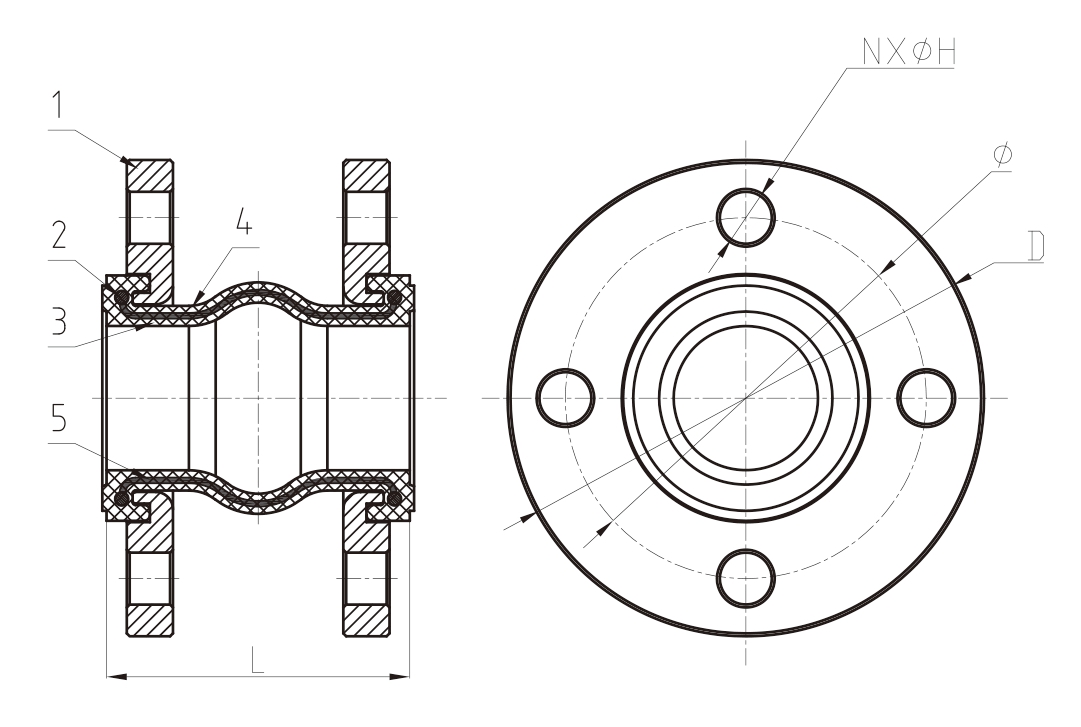
Movement Profile: This design features a single spherical bellow between two flanges. It offers a balanced, standard range of axial and lateral movement. The single arch provides predictable, uniform flexing under moderate pressure.
Application: A single ball rubber expansion joint is best for general vibration isolation and moderate thermal changes in standard industrial HVAC or water treatment applications. When you need straightforward pump isolation, this profile delivers reliable results. It maintains structural stability well without requiring complex anchoring.
Movement Profile: By adding a second spherical arch, the flexibility multiplies. It provides significantly higher movement capacities (often double) for axial, lateral, and angular deflection compared to single sphere models. The dual bellows act like a more forgiving accordion.
Application: Required for systems with severe vibration, extensive thermal expansion, or larger offset requirements. A double sphere rubber expansion joint handles extreme mechanical environments brilliantly. Note: They may require lower pressure ratings or root rings for stability. Under high internal pressure, the middle section can balloon outward. Stabilizing rings prevent this uncontrolled swelling.
Movement Profile: Designed for smaller diameter piping, offering high flexibility in a compact footprint. Instead of heavy bolted flanges, it utilizes female threaded union ends. The internal elastomer acts as a continuous tube.
Application: Ideal for tight installations requiring threaded connections rather than flanged ends. A union rubber expansion joint is commonly used in residential or light-commercial plumbing. Fan coil units, small booster pumps, and localized heating loops benefit greatly from this compact design. It absorbs high-frequency hums efficiently.
Selecting the proper joint requires more than picking a movement profile. You must evaluate the operating environment holistically. Fluid Sealing Association (FSA) guidelines emphasize looking at interconnected variables.
The STAMPED Framework Integration
We use this industry-standard mnemonic to contextualize movement limits accurately:
Pressure/Temperature Derating
Manufacturer catalogs list maximum movement capabilities at ambient room temperatures. You must demonstrate that maximum movement and maximum pressure/temperature cannot be achieved simultaneously. High temperatures reduce the rubber's modulus, thereby lowering allowable movement thresholds. If your system runs at 200°F (93°C), the elastomer softens. Operating at maximum rated pressure at this temperature causes premature failure. Always consult published derating tables to find your adjusted operational envelope.
Concurrent Movements
Piping systems rarely experience just one force. They shrink axially while settling laterally. Calculating combined movement is critical. If a joint is subjected to both axial compression and lateral deflection simultaneously, the maximum allowable limit for each is reduced. This is often calculated via a percentage formula. For example, if you consume 60% of the rated axial movement, you only have 40% of the lateral movement capacity remaining. Exceeding 100% combined capacity fractures the fabric reinforcement.
Control Units (Tie Rods)
Understanding when and why to use them prevents blowouts. They are essential for preventing over-extension (limit rods) or excessive compression when piping is unanchored or subjected to pressure thrust forces. Internal fluid pressure pushes outward in all directions. It tries to push the pipe ends apart. If your anchors fail, the joint stretches. Tie rods physically stop the flanges from expanding past their engineered yield points.
Even a perfectly specified component fails if installed incorrectly. Real-world implementation requires strict adherence to mechanical best practices.
Pre-Compression/Pre-Extension Errors
Installation crews sometimes use the joint to fix sloppy pipework. Beware the risk of installing a joint already compressed or stretched to fit misaligned pipes. Doing this instantly consumes its available movement allowance. If a joint can compress 1 inch, and you compress it 0.75 inches just to squeeze it between two flanges, it only has 0.25 inches left for actual thermal expansion. Once operational heat hits, the joint crushes itself.
Anchoring and Guiding Realities
An expansion joint is useless if the pipe itself isn't properly anchored. Expansion joints do not dictate pipe movement; they simply absorb it. The piping system must dictate directional movement into the joint using main anchors and pipe guides. Place a main anchor directly after the joint. Use concentric pipe guides further down the line. This forces thermal growth to travel linearly directly into the elastomeric bellows, rather than bowing out laterally.
Mating Flange Compatibility
Elastomers are softer than steel. Ensuring flat-faced flanges are used prevents damage to the rubber bead. Raised-face flanges act like cookie cutters. When you tighten the bolts, the raised edge slices into the rubber sealing face, causing immediate leaks. Furthermore, you must verify proper torque sequencing to avoid crushing the elastomer. Use a star-pattern tightening sequence. Make three gradual passes with a calibrated torque wrench. Never over-tighten.
Managing dynamic stress effectively protects your entire infrastructure from premature failure. Specifying the right joint means aligning the calculated system movements (axial, lateral, angular) with the specific joint architecture (single, double, union) while factoring in operational pressure and temperature. You cannot treat these components as universal fixes for bad pipe layout.
To ensure a secure installation, take these immediate next steps:
A: While they can absorb minor angular and lateral offset, they should never be used as a primary solution for poor pipe installation. Forcing a joint into place consumes its movement capacity and shortens its lifespan. Pipes must align properly before bolting.
A: This typically indicates excessive lateral movement, a lack of stabilizing root rings, or operating beyond its temperature-adjusted pressure limits. High internal pressure inflates the unsupported middle section. You may need control rods to manage the thrust forces.
A: Not always, but they are highly recommended (and often mandatory for safety) in unanchored systems to absorb pressure thrust forces and prevent the joint from expanding past its structural limit. They act as essential fail-safes.
A: Torsion causes shearing between the layers of the elastomer and the fabric reinforcement, leading to rapid, catastrophic failure. Twisting immediately voids the warranty. Systems must be designed with guides to eliminate twist entirely.